
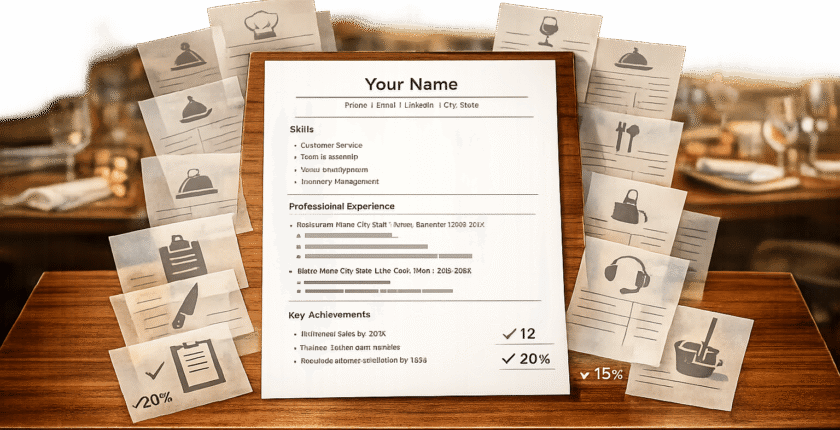
How to Write a Resume When You’ve Worked at 10 Restaurants
If you’ve worked at 10 restaurants, your resume might seem scattered, but it can actually position you as a strong candidate for management roles. The key is to frame your experience as a showcase of skills, growth, and accomplishments. Here’s how to do it:
- Choose the Right Format: Use a combination resume to highlight your skills upfront while summarizing your work history. This approach keeps the focus on your expertise and avoids overwhelming recruiters with too many job titles.
- Craft a Strong Summary: Start with a concise professional summary that highlights your years of experience, key skills, and measurable achievements.
- Focus on Transferable Skills: Highlight skills like team leadership, inventory management, and customer service. Use action verbs and metrics to make your accomplishments stand out.
- Group and Organize Roles: Instead of listing every job chronologically, group roles by function, restaurant type, or skill area to emphasize your strengths and show consistency.
- Address Job-Hopping Concerns: Use years-only formatting for dates and add context in your cover letter if necessary. Highlight how each role contributed to your growth and expertise.
From Bland to Brilliant: Upgrade Your F&B Manager Resume in under 3 Minutes
sbb-itb-306cd44
Select the Right Resume Format
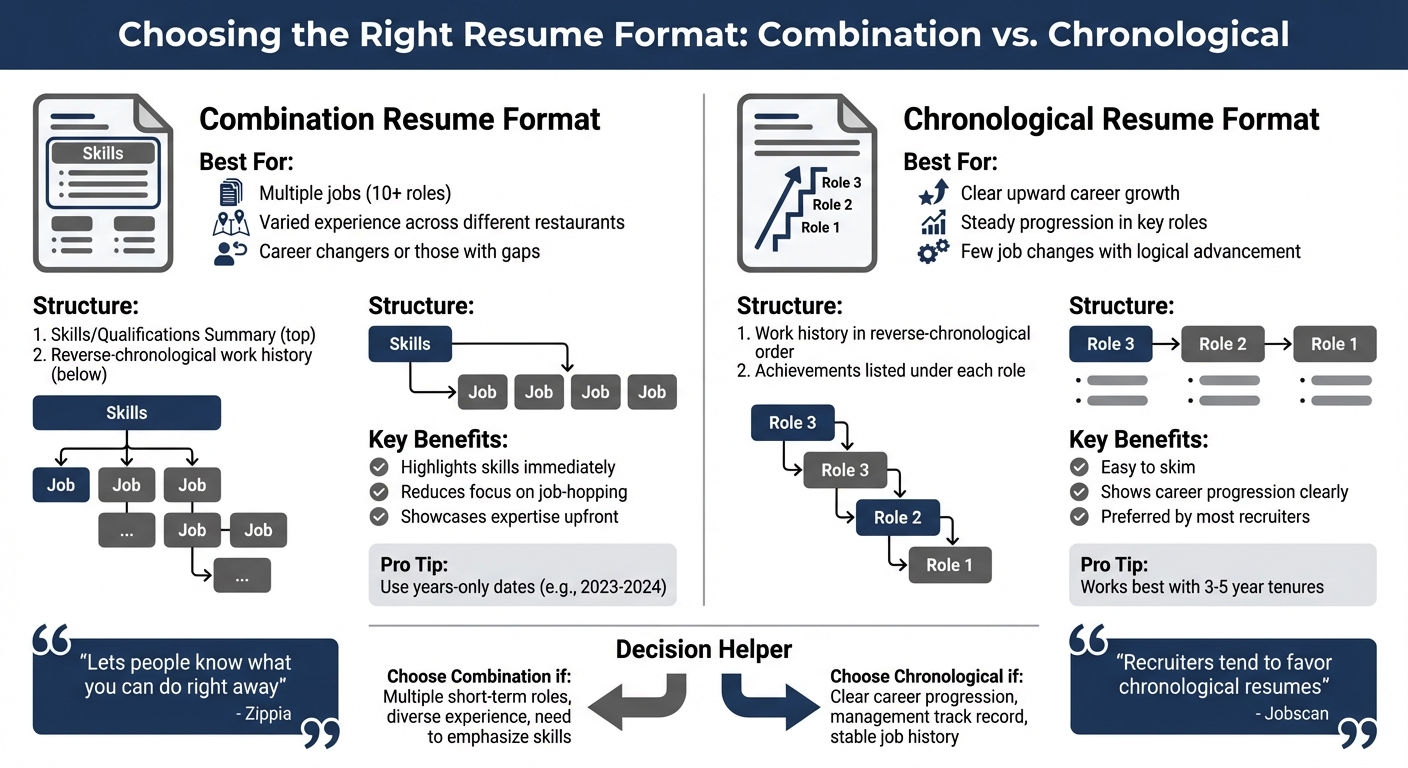
Restaurant Resume Format Comparison: Combination vs Chronological
The resume format you pick can make or break how hiring managers perceive your experience. If you’ve juggled multiple roles – say, 10 or more – then the combination resume could be your best bet. This format strikes a balance by showcasing a detailed skills section at the top, followed by a reverse-chronological work history. It ensures your top skills, like high-volume service management or team training, take center stage rather than overwhelming recruiters with a long list of job titles.
"The reason the combination resume works so well is that it lets people know what you can do right away. It grabs their interest and puts you out there as a skilled candidate." – Zippia
Why the Combination Format Works
The combination format is ideal for shifting the focus from the sheer number of jobs you’ve held to the skills and expertise you’ve gained. By starting with a "Qualifications Summary" or "Key Skills" section, you highlight your operational strengths – think inventory management, staff scheduling, or conflict resolution – right at the top. Since recruiters often skim resumes in just seconds, this approach ensures they notice what you bring to the table before diving into your job history.
Neely Raffellini, founder of 9 to 5 Project, explains: "It gives you a chance to show chronology and evolution, but also a chance to pinpoint skills you want to point out." For restaurant professionals, this could mean grouping similar roles under categories like "Lead Server" or "Kitchen Management" to show consistency across various jobs. To further streamline your timeline, you might list only the years (e.g., "2023–2024") rather than specific months, which can help smooth over shorter stints.
When to Use a Chronological Format
If your restaurant career shows clear upward growth – like moving from shift lead to assistant manager over a few years – the chronological format might be a better fit. This format, often preferred by recruiters, lays out your work history in a straightforward way, making it easy to see steady progression in key roles. Hogan Short, a content writer at Jobscan, puts it simply: "Recruiters like me tend to favor chronological resumes. They’re easy to skim, and they give us a quick snapshot of your career progression."
The chronological format works best when your career path is clear and doesn’t require much explanation. For example, if you’ve held management positions at a handful of restaurants over several years, this format allows you to highlight achievements within each role. However, if your work history includes frequent job changes or lateral moves, a chronological resume might raise questions. Be honest about your background and choose the format that best presents your strengths.
Once you’ve selected your format, focus on crafting a professional summary that showcases your standout skills and accomplishments.
Write a Professional Summary
Your professional summary is the first thing recruiters will see on your resume – it’s your chance to make a strong impression right away. Think of it as a 30-second pitch that highlights your value and sets the tone for the rest of your resume. For restaurant professionals with diverse experience, this is where you can turn variety into a strength. Start with your professional title and years of experience, such as: "Experienced Restaurant Manager with 8+ years in high-volume operations." Follow it up with a standout achievement and a brief overview of your key skills.
"Your restaurant manager resume objective needs to outline your experience, your strengths, and why you’re the right candidate for the job."
– Jamie Thork, Monster Contributor
Keep it concise – 3 to 4 sentences max – since recruiters typically spend only 6 to 8 seconds scanning a resume. If you’ve worked at multiple locations or handled different types of restaurants, highlight this as a strength, showcasing your ability to thrive in various environments. Include achievements in areas like launching new locations, turning around underperforming establishments, or managing growth in high-demand settings.
Focus on Transferable Skills
Even if you’ve worked at 10 different restaurants, many of the skills you’ve developed are likely transferable. Emphasize areas like leadership, profit-and-loss management, cost control, and team development. Highlight specific capabilities such as mentoring staff, analyzing financial performance, improving operational workflows, and resolving customer issues. Use action-oriented language to show initiative – verbs like "Spearheaded", "Streamlined", "Revamped," or "Engineered" can make your achievements pop. Avoid passive phrasing like "responsible for managing staff" and opt for direct, impactful statements instead.
Include Measurable Achievements
Hiring managers love numbers – they tell a clearer story than adjectives ever could. Instead of saying you "improved efficiency", say you "increased operational efficiency by 30%" or "reduced food waste by 10%. Metrics like revenue growth, labor cost reductions, employee retention, and customer satisfaction scores are especially compelling.
For example, at Botanica Bistro (starting March 2019), a Restaurant Manager reduced turnover by 15% through mentorship programs and cut food waste by 10% using improved supplier contracts, resulting in a 12% cost reduction. Similarly, at The Urban Spoon in Tampa, FL, between March 2023 and November 2025, Restaurant Manager John Patel increased customer satisfaction by 25%, boosted weekend sales by $20,000, and cut annual supply costs by 15% with optimized inventory management.
When crafting your summary, lead with your experience level and tie it to a measurable success. For instance: "Results-driven manager with 7+ years of experience and a proven track record of increasing sales by 20% while reducing labor costs by 12%. This approach ensures your professional summary reflects your impact, immediately setting you apart from other candidates.
Structure Your Restaurant Experience
How you present your work history can make or break your resume. With recruiters spending just 6 to 20 seconds on an initial scan, your format needs to grab attention quickly and effectively.
Zero in on the experiences that best match the job you want. If you’ve held multiple roles at the same restaurant, list the restaurant once and include your titles and dates underneath. This approach highlights your career growth while avoiding the impression of job-hopping. From there, organize your roles into clear sections that immediately showcase your strengths.
Group Roles by Restaurant Type or Function
Instead of listing jobs strictly in chronological order, consider grouping them by restaurant type or job function. For example, you could create categories like "Fine Dining Experience", "High-Volume Casual Dining", or "Fast-Casual Operations." This method highlights your ability to excel in different service environments and emphasizes specialized expertise.
Another option is to group similar roles across different locations by function. For instance, instead of repeating similar duties under each restaurant, use categories like "Management Roles" or "Front-of-House Leadership." This "bucketing" technique organizes related responsibilities under subheadings, making your skills stand out at a glance. Just remember to keep the roles within each category in reverse-chronological order to stay compatible with applicant tracking systems (ATS).
Organize Accomplishments by Skill Area
You can also structure your achievements under skill-based subheadings rather than listing them randomly under each employer. Categories like Operations Management, Team Leadership, Revenue & Sales Growth, Inventory Management, and Customer Service work well for restaurant resumes. This approach not only avoids repetition but also highlights your expertise in key areas that matter to hiring managers.
For example, under "Operations Management", you might include achievements like "streamlined kitchen workflows, reducing prep time by 15%" or "cut overhead costs by 12%." In "Team Leadership", you could showcase accomplishments such as "trained and mentored 15 new hires, improving retention rates by 20%." Use bold text to call attention to measurable results, and always start bullet points with strong action verbs like "Spearheaded", "Optimized", or "Resolved" to convey initiative and leadership.
Here’s a quick reference table to help you decide how to structure your experience:
| Grouping Category | Example Subheadings | Best For |
|---|---|---|
| By Function | Operations, Leadership, Customer Service | Highlighting specific management expertise |
| By Restaurant Type | Fine Dining, Casual Dining, Catering | Showing adaptability across service styles |
| By Skill Area | Inventory Control, Staff Training, Revenue Growth | Emphasizing measurable business impact |
| By Role Level | Management Roles, Front-of-House, Back-of-House | Clarifying career progression and hierarchy |
Handle Job-Hopping Concerns
Once you’ve organized your varied restaurant experience, it’s time to address any potential concerns about job stability. Sure, working at 10 different restaurants might raise eyebrows, but it also highlights your versatility and wide-ranging expertise. Here’s an encouraging stat: only 50% of hiring managers currently view frequent job-hopping as a red flag. Even better, 59% of employers take either a positive or neutral stance on it. In the restaurant world, turnover is expected – after all, the median tenure for workers aged 25 to 34 is just 2.8 years. Your diverse background can make you stand out, showcasing adaptability and a skill set that someone with a single-employer history might not have.
Use Industry Standards to Your Advantage
Restaurant work is naturally fast-paced and transient, and hiring managers know this. Highlight your roles as proof of your adaptability and ability to thrive in different environments. If a job was short-lived due to closures, seasonal work, or restructuring, include a brief "Reason for leaving" note next to those positions. For example, you could write "Reason for leaving: Restaurant closed due to pandemic" or "Reason for leaving: Seasonal position."
Consider using a "years-only" format for your employment dates to emphasize stability, even with shorter roles. This formatting can help reinforce the idea that each job added to your professional growth.
Provide Context in Your Cover Letter
Your cover letter is the perfect place to connect the dots between your various roles and present a cohesive career story. Use it to explain how your experiences have prepared you for the role you’re applying for. Be straightforward and concise about why you moved between jobs – whether it was for better opportunities, skill-building, or higher pay. Then, shift the focus to why you’re now looking for a long-term position with room for growth.
"Use the cover letter to polish the resume. Tweak the resume to sell your strengths so hard that your ‘weaknesses’ are more difficult to spot. Then spin the whole thing into a convincing tale of you being the perfect fit." – Peter Jones, Career Blogger
If a role ended because of a cultural mismatch, avoid negative remarks about your former employer. Instead, focus on what you learned from the experience and how the values of the company you’re applying to align with your goals. This approach shows hiring managers that you’ve carefully chosen their organization as the place to build stability and make a meaningful impact. With these strategies, you can turn a history of short-term roles into a compelling, growth-oriented career narrative.
Customize Your Resume for Management Roles Using RR Guy
Once you’ve organized your restaurant experience effectively, the next step is tailoring your resume to highlight your readiness for management. Your background has equipped you with a range of skills that can transition seamlessly into roles like General Manager or Kitchen Manager. The key is aligning your achievements with what employers are looking for.
Match Skills to Management Position Requirements
Landing a management role takes more than generic statements like "managed staff." Employers want specifics – expertise in areas like P&L analysis, labor cost control, inventory management, and menu engineering. To stand out, reflect the job description’s language. This also helps your resume pass ATS (Applicant Tracking Systems), which are used by 97.8% of Fortune 500 companies, including major chains like Chipotle and Olive Garden. Keep in mind, over 75% of resumes never make it past ATS software to a human reviewer.
Here’s a simple formula to follow: Action Verb + Task + Measurable Result. For instance: "Reduced food waste by 22% through new inventory tracking protocols". If you’ve led teams across multiple locations, quantify your impact. For example: "Managed a team of 35+ employees, reducing turnover by 15% in 12 months." Highlight relevant technologies you’ve used, such as Toast, Square, or Micros POS systems, and tools like HotSchedules. Don’t forget certifications like ServSafe or TIPS to reinforce your focus on safety and compliance[45,46].
"Most restaurant manager resumes fail because they read like job descriptions instead of achievement stories." – The Interview Guys
Your ability to deliver measurable results across various restaurants showcases the leadership employers expect in management roles. The next step is to align your proven skills with specific job requirements.
Use RR Guy’s Resume and Job Search Tools
RR Guy simplifies your job search with a curated board featuring management opportunities across fast-casual, full-service, fine dining, and hotel settings. Their "Submit Your Resume" feature connects you with recruiters who specialize in the restaurant industry, ensuring your application reaches the right audience. Best of all, it’s free for candidates and includes tailored resume guides for roles like General Manager, Kitchen Manager, and Executive Chef. These guides offer ATS-friendly keywords and examples of measurable bullet points to help you stand out.
You can also set up job alerts to get instant notifications about openings that match your skills. RR Guy’s tools include action verb lists and metrics-based frameworks specifically designed for restaurant leaders. Use their professional summary framework to replace outdated objective statements with a concise, 3–4 sentence pitch that highlights your experience and top achievements.
"We’re not some faceless staffing agency blasting résumés into the void. We’re the middle finger to generic job sites, built for people who know what they’re worth." – RR Guy
With an optimized resume and RR Guy’s resources, you’re well-equipped to take the next step in your management career.
Conclusion
Working at 10 restaurants showcases your ability to learn quickly, adapt to new environments, and deliver consistent results. The key is to present this experience strategically. Using the combination resume format allows you to focus on your skills and accomplishments first, steering attention toward measurable achievements rather than a detailed timeline of roles. This approach creates a solid foundation for a compelling professional summary.
When crafting your summary, connect your varied experiences by highlighting transferable skills like P&L management, team leadership, and conflict resolution. Use the STAR method to emphasize measurable results – for example, "increased server sales by 16% within six months". Grouping similar roles together can illustrate growth and progression, while roles that don’t add value can be omitted entirely.
To address concerns about job-hopping, list only the years of employment and briefly explain career transitions. In the restaurant industry, frequent moves are common, with a turnover rate of 6.4% in 2021 – more than double the national average. Use your cover letter to add context, demonstrating your dedication and readiness for the next opportunity.
FAQs
How many restaurant jobs should I list?
When listing restaurant jobs from the past 10 to 15 years, focus on roles that directly showcase your skills and align with the position you’re applying for. Quality matters more than quantity – choose positions that highlight your strengths and demonstrate your experience effectively.
For example, include roles like:
- Restaurant Manager: Showcases leadership, team management, and operational expertise.
- Head Chef or Sous Chef: Highlights culinary skills, menu planning, and kitchen management.
- Server or Bartender: Demonstrates customer service, multitasking, and upselling abilities.
- Host/Hostess: Reflects organizational skills and a focus on guest experience.
Tailoring your resume to highlight these roles ensures you present a clear and compelling case for your qualifications without overwhelming the reader.
Should I use a combination or chronological resume?
A combination resume works well when you want to emphasize both your skills and work experience. It’s especially useful if you’ve had a varied job history, like working at several restaurants. This format allows you to highlight transferable skills while neatly organizing your diverse roles.
How do I explain short stints without hurting my chances?
When explaining your career transitions, concentrate on the positive reasons behind each move, like pursuing growth or seizing exciting opportunities. Showcase the skills and expertise you developed in every role, and present your decisions as strategic steps that align with your long-term goals. Rather than focusing on the shorter durations of your positions, emphasize how your unique experiences make you an ideal fit for the role you’re pursuing.