
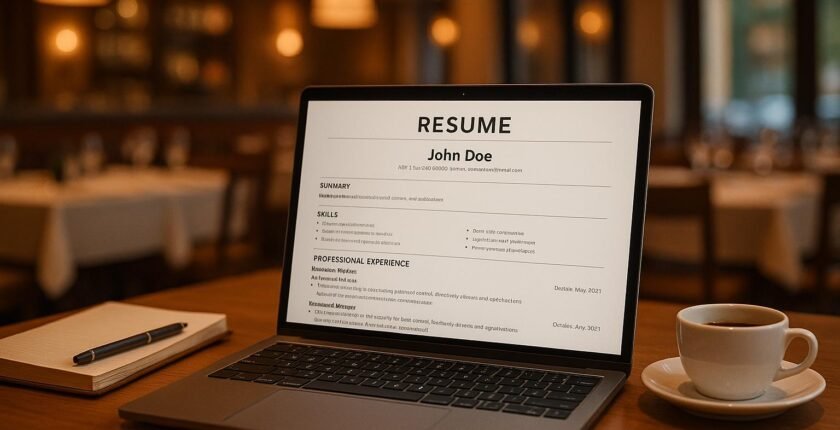
How to Write a Winning Restaurant Manager Resume
Your restaurant manager resume is your ticket to standing out in a competitive industry. To get noticed by hiring managers – and applicant tracking systems (ATS) – you need to focus on measurable achievements, clear formatting, and the right keywords. Here’s a quick breakdown of what matters most:
- Highlight Key Metrics: Showcase results like revenue increases, cost reductions, or improved customer satisfaction.
- Optimize for ATS: Use job-specific keywords like "P&L management", "staff training", and "inventory control."
- Tailor for the Job: Customize your resume for the specific type of restaurant (fine dining, casual dining, or fast casual).
- Focus on Skills and Certifications: Include technical skills (e.g., POS systems) and industry certifications (e.g., ServSafe).
- Keep it Clean and Professional: Use a simple layout, reverse-chronological format, and save as a PDF unless otherwise specified.
How To Write A Restaurant Manager Resume? – Job Success Network
What Restaurant Managers Do: Core Duties and Skills
Restaurant managers juggle a variety of responsibilities every day, from organizing staff schedules to ensuring compliance with food safety standards. Knowing these key responsibilities can help you pinpoint the experiences and accomplishments to highlight on your resume. The role requires a mix of business know-how, strong interpersonal skills, and operational savvy, which can differ depending on the type of restaurant you’re managing. These responsibilities serve as a roadmap for tailoring your resume to showcase the skills employers are looking for.
Main Duties of Restaurant Managers
Daily Operations and Service Excellence:
Keeping the restaurant running smoothly during busy times is a top priority. This includes maintaining high food quality, resolving customer issues quickly, managing kitchen operations, coordinating with front-of-house staff, and making quick decisions to address challenges as they arise.
Team Leadership and Staff Development:
Managers handle recruiting, training, and scheduling staff, while also conducting team meetings and setting performance standards. They often oversee training programs focused on food safety and customer service to ensure consistency and quality.
Financial Management and Cost Control:
From tracking sales and managing inventory to reducing waste, restaurant managers play a key role in maintaining profit margins and ensuring financial health.
Compliance and Safety Oversight:
Staying on top of local, state, and federal regulations is critical. This includes preparing for health inspections, documenting food safety practices, and ensuring staff follow alcohol service laws and workplace safety guidelines.
These day-to-day responsibilities naturally tie into the essential skills that make a restaurant manager successful.
Key Skills for U.S. Restaurant Managers
The skills below, derived from the core duties of restaurant management, are important to emphasize in your resume.
Staff Development and Training:
A strong manager recognizes team strengths and areas for improvement, creates development plans, and fosters a supportive workplace. This not only boosts morale but also helps reduce staff turnover – a big win in today’s competitive job market.
Financial Analysis and Budget Management:
Understanding profit and loss statements, monitoring food and labor costs, and finding ways to improve efficiency are vital for keeping the restaurant profitable.
Technology Proficiency:
Being comfortable with tools like point-of-sale systems (e.g., Toast, Square, Clover), inventory management software, and scheduling apps is essential. Many restaurants also rely on customer relationship management tools and social media platforms for marketing.
Customer Service and Conflict Resolution:
Maintaining a restaurant’s reputation means handling customer complaints effectively, managing online reviews, and training staff to deliver consistent, high-quality service.
Regulatory Knowledge and Compliance Management:
A thorough understanding of food safety regulations, alcohol service laws, employment standards, and local health codes is crucial to avoid violations and ensure the safety of both staff and customers.
Inventory and Supply Chain Management:
Managing inventory efficiently involves keeping stock levels just right, minimizing waste, and controlling costs. This often requires building strong supplier relationships, negotiating contracts, and using systems to track product usage and expiration dates.
How to Format Your Restaurant Manager Resume
The way you format your resume can make all the difference in landing an interview. A clean, organized layout not only helps hiring managers quickly locate key information but also reflects your professionalism and attention to detail – qualities that are essential for any restaurant manager.
Basic Resume Sections and Layout
Your restaurant manager resume should be divided into five key sections: header, summary, experience, education, and skills. Start with a professional header that includes your full name, phone number, city, state, and a professional email address.
The professional summary should be a concise, 3-4 line overview of your experience and key qualifications.
The professional experience section is the centerpiece of your resume. List your roles in reverse chronological order, starting with your current or most recent job. For each position, include the job title, employer name, location (city and state), and your employment dates. Use bullet points to describe your responsibilities and achievements, focusing on measurable results wherever possible.
Next, add an education section. Unless you’re a recent graduate with limited work experience, this section should follow your professional experience. Include your degree, the institution’s name, location, and your graduation year. If you graduated more than a decade ago, you can leave out the graduation year.
Finally, include a skills section tailored to the job description. Highlight both technical skills, like proficiency with POS systems and inventory software, and soft skills, such as leadership and conflict resolution. Be sure to include any relevant certifications, such as food safety or alcohol service training.
Consistency is key when formatting your resume. Use the same font style and size throughout, keep spacing uniform, and align your bullet points. Opt for professional fonts like Arial, Calibri, or Times New Roman in sizes 10-12 for the body text.
U.S. Resume Format Rules
Adhering to U.S. formatting standards is important when applying for jobs in the United States. It shows attention to detail and familiarity with local business norms.
- Dates: Use the U.S. date format (MM/DD/YYYY) or spell out the month, such as "January 2023."
- Locations: Always include both city and state, e.g., "Miami, FL" or "Denver, CO."
- Financial figures: Place the dollar sign ($) before numbers and use commas for thousands, like "$1,200,000 in annual sales."
- Percentages: Write percentages with the symbol directly after the number, such as "20% increase in customer satisfaction."
- Phone numbers: Format as (XXX) XXX-XXXX for a polished look.
- Language: Stick to American English. For example, use "analyze" instead of "analyse" and "labor costs" instead of "labour costs."
These details may seem small, but they help your resume stand out and demonstrate cultural awareness.
Resume Length and File Type Guidelines
The length of your resume depends on your level of experience.
For those with less than 10 years of experience, keep it to one page. This forces you to focus on the most relevant and impactful information. If you’re applying for entry-level or assistant manager roles, your resume should fit on a single page.
If you’re an experienced restaurant manager with over 10 years in the industry or applying for senior roles like regional manager, a two-page resume is acceptable. However, make sure every detail on the second page adds value. The first page should contain your most compelling qualifications, ensuring that even a quick glance leaves a strong impression.
When it comes to file formats, PDF is your best option unless the job posting specifies otherwise. PDFs maintain your formatting across devices, ensuring your resume looks polished. Save your file with a clear, professional name like John_Smith_Restaurant_Manager_Resume.pdf. Avoid generic names like "Resume.pdf."
Some Applicant Tracking Systems (ATS) may struggle with complex PDF formatting. If you’re applying through an online portal and notice issues, consider submitting a Word document (.docx) instead. However, PDFs are generally the safest choice for email and most online applications.
Before submitting, check how your resume looks on different devices to ensure it displays correctly. A little extra effort in formatting can make a big difference in your job search.
How to Present Your Work Experience and Results
Your work experience section is your chance to demonstrate your impact as a restaurant manager. Use this space to highlight your achievements by focusing on measurable results, like increasing revenue or cutting costs.
Using Numbers to Show Your Success
Numbers tell a compelling story. Instead of vague statements like "increased restaurant sales", be specific about your accomplishments. For example, explain how your marketing efforts boosted sales by 15% or how you introduced cost-saving measures that reduced expenses by 10%. These details make your contributions tangible.
When describing staff management, avoid generic phrases like "managed a team." Instead, specify the size of your team and the improvements you brought about, like raising employee retention rates or enhancing productivity through targeted training programs. If you handled scheduling, detail how your approach improved efficiency and service quality.
Customer satisfaction is another area where numbers can shine. Don’t just say you "improved customer service." Share specifics, such as increasing customer satisfaction scores by 20% or driving up repeat business through loyalty programs or personalized service.
For operational efficiency, highlight how you streamlined processes. Maybe you cut average service times by 5 minutes or increased daily table turnover without needing extra staff. These examples show your ability to optimize operations effectively.
Showing Career Growth in Management Roles
Once you’ve detailed your accomplishments, illustrate how your role has evolved over time. Your resume should reflect your professional growth and increasing responsibilities. If you’ve been promoted within the same company, list each position separately, showing how your duties expanded from basic tasks to strategic business oversight.
For instance, you might start with an assistant manager role, where you focused on daily operations and team coordination. Then, as a general manager, emphasize responsibilities like overseeing budgets, implementing cost-control strategies, and driving profitability. Highlighting leadership activities, such as mentoring new hires or developing training programs, reinforces your upward trajectory and showcases your ability to take on greater challenges.
Including Industry Tools and Certifications
Adding industry tools and certifications to your resume strengthens your credibility. If you’ve mastered point-of-sale (POS) systems like Toast POS, Square for Restaurants, or Aloha POS, mention them. Explain how these platforms improved transaction speed or order accuracy in your restaurant.
Similarly, if you’ve used inventory or scheduling software, describe how these tools helped you manage labor costs or streamline inventory processes. For example, you might note how using scheduling software reduced overtime costs by 15%.
Certifications are equally important in restaurant management. Include credentials like the ServSafe Manager Certification or the National Registry of Food Safety Professionals Manager Certification. If you hold state-specific alcohol service certifications, be sure to list those as well.
Additionally, if you’re skilled with financial tools like QuickBooks or Restaurant365, mention how you used them to manage budgets, track P&L statements, or monitor key performance indicators. Extra certifications, such as Certified Hospitality Supervisor (CHS) or Lean Six Sigma Yellow Belt, can also set you apart. Briefly explain how they’ve helped you implement process improvements or achieve cost savings in your previous roles. These details show you’re not just experienced – you’re equipped with the tools and knowledge to deliver results.
sbb-itb-306cd44
Important Skills and Keywords for Restaurant Manager Resumes
Your skills section is one of the most important parts of your restaurant manager resume. Why? Because hiring managers – and the applicant tracking systems (ATS) they use – look here first to identify key qualifications. Many companies rely on ATS software to filter resumes based on specific keywords before they’re even seen by a human.
To stand out, you need to strike the right balance between hard skills (technical expertise) and soft skills (interpersonal abilities). At the same time, it’s crucial to include industry-specific terms that ATS systems are programmed to recognize. This combination shows you have both the know-how and leadership qualities to run a restaurant effectively.
Top Skills for Restaurant Management Jobs
Managing a restaurant successfully means wearing many hats – operations, finance, customer service, and team leadership. Here are some of the most sought-after skills to highlight:
- Financial Management: Employers want to see your ability to manage budgets, control costs, and analyze profit and loss. Experience with labor cost management, food cost percentage control, and revenue forecasting will make your resume stand out.
- Food Safety Compliance: This is non-negotiable in the industry. Showcase your knowledge of HACCP protocols, health department regulations, and sanitation standards. If you’ve maintained inspection records or implemented food safety training programs, be sure to mention it.
- Team Leadership and Staff Development: Strong leadership is essential. Highlight skills like conflict resolution, performance management, and training program development. Include examples of successful hiring, scheduling, and employee retention efforts.
- Customer Service Excellence: Show your ability to improve customer satisfaction scores or enhance the guest experience. Experience with loyalty programs or customer feedback systems adds measurable value.
- Inventory Management: Operational efficiency is a big deal. Demonstrate your skills in vendor relations, supply chain management, and waste reduction. If you’ve worked with specific inventory tracking systems, include them.
- Technology Proficiency: Modern restaurant management relies heavily on technology. Mention your experience with restaurant management software, scheduling platforms, and digital ordering systems. If you’ve handled marketing through social media, that’s worth noting too.
By aligning these skills with industry-specific keywords, you’ll show both practical expertise and a forward-thinking approach – making your resume stand out in a competitive field.
Making Your Resume ATS-Friendly
Once you’ve identified the key skills to include, it’s time to make sure your resume is optimized for ATS systems. These tools scan resumes for keywords and phrases that match the job description, so using the right terms is critical.
Here are some tips to make your resume ATS-friendly:
- Use Job-Specific Keywords: Review job postings carefully and identify repeated keywords. Common terms for restaurant managers include "P&L management", "inventory control", "labor scheduling", "staff training", "customer satisfaction", and "operational efficiency." Use these exact phrases where appropriate.
- Match the Job Description: If a job posting emphasizes "team leadership", use that specific phrase instead of alternatives like "staff management" or "employee supervision." ATS systems often rely on precise wording.
- Incorporate Keywords Naturally: Keywords shouldn’t feel forced. For example, instead of saying "managed restaurant operations", try "oversaw daily restaurant operations, including inventory control, staff scheduling, and customer service standards."
- Stick to Simple Formatting: Avoid graphics, tables, or unusual layouts that might confuse ATS software. Use standard fonts like Arial or Times New Roman, and save your resume as both a Word document and a PDF to ensure compatibility.
- List Certifications and Software Clearly: Include full names and abbreviations for certifications and tools. For example, write "ServSafe Manager Certification (ServSafe)" or "Toast Point of Sale System (Toast POS)" to capture all keyword variations.
Lastly, platforms like RR Guy’s job board can help you find positions that align with your skills and experience. You can filter job postings by restaurant type, location, and management level, making it easier to target roles where you’re a perfect fit.
Customizing Your Resume for Different Restaurant Jobs
Restaurant jobs come in all shapes and sizes, and to truly stand out, you need a resume that reflects the specific demands of the role you’re targeting. By building on your core achievements and tailoring your resume to align with the unique priorities of each restaurant type, you can demonstrate you’re the right fit for the job.
Adjusting Resumes for Different Restaurant Types
Fine Dining restaurants are all about sophistication, exceptional service, and culinary artistry. If you’re applying to an upscale establishment, highlight your expertise with premium ingredients, wine pairings, and creating unforgettable dining experiences. Take Emma Weber, for instance. At La Belle Époque in Boston, she increased revenue by 25% with seasonal menus and wine pairings, all while maintaining a 95% customer satisfaction rate. Her Certified Sommelier credential and collaborations with executive chefs on innovative menus are exactly the kind of qualifications fine dining employers look for.
When crafting a resume for fine dining, focus on achievements like:
- "Collaborated on menu redesign, driving a 15% increase in à la carte sales."
- "Trained staff on wine pairings, boosting wine-by-the-glass revenue by 20%."
These details show you understand the refined service and high standards that define fine dining.
Casual Dining calls for a mix of quality service and operational efficiency. William Thompson’s tenure at Lone Star Grill in Austin is a great example. He increased sales by 18% year-over-year with new menu items and promotions, while cutting food costs by 5% through smarter inventory management. His ability to deliver a 4.7/5 customer satisfaction rating while keeping costs under control reflects the balance casual dining managers need.
For casual dining roles, showcase accomplishments like:
- "Managed operations across three locations, achieving 10% annual revenue growth."
- "Launched menu promotions that increased average checks by 8% regionally."
These examples prove you can manage profitability while keeping customers happy.
Fast Casual and Quick Service environments prioritize speed, consistency, and efficiency. Sofia Ramirez’s work at Burger Blast in Chicago is a perfect illustration. She improved drive-thru efficiency by 25%, cutting wait times from 3 to 2.25 minutes, and implemented training protocols that reduced order errors by 30%. Serving over 1,000 customers daily showcased her operational expertise.
For fast-casual roles, highlight metrics like:
- "Reduced drive-thru wait times by 20%."
- "Implemented cross-training, lowering labor costs by 12% while maintaining service quality."
These numbers demonstrate your ability to thrive in high-pressure, high-volume settings.
"To enhance your job search as a restaurant manager candidate, tailor your resume and cover letter for each application, emphasizing relevant skills and experiences." – Chris Shatto, Hospitality Recruiter and Expert Contributor, Gecko Hospitality
Pro tip: Add a short description of each restaurant you’ve worked at directly under its name in your experience section. For example:
"Restaurant Manager, Coastal Bistro (180-seat upscale casual dining, $2.5M annual revenue)."
This gives hiring managers instant insight into the scope of your experience.
Using RR Guy‘s Job Board Features
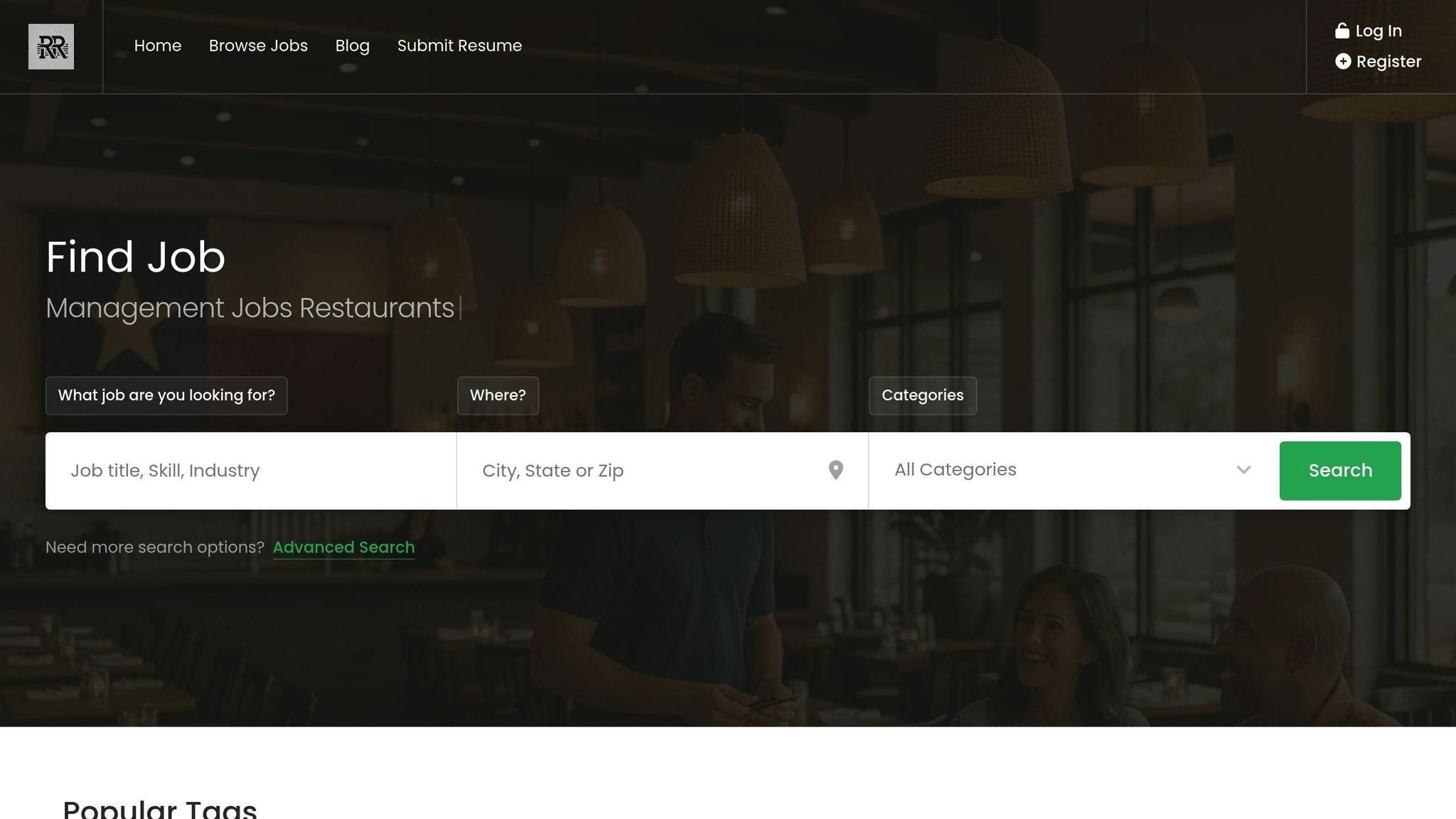
Once your resume is tailored to your target restaurant type, take advantage of specialized tools to connect with the right opportunities. RR Guy’s job board is designed specifically for restaurant management roles, making it an ideal resource for your search.
The advanced search options allow you to filter by restaurant type, location, and management level, so you can zero in on roles that match your experience and goals. Set up job alerts to receive notifications for specific categories, like "fine dining manager Boston" or "fast casual regional director Texas." This ensures you can apply as soon as positions are posted, giving you a competitive edge.
Use the candidate dashboard to keep your applications organized. This feature helps you track which version of your resume you sent to each employer and when to follow up. Additionally, the browse by category tool is great for research – review job descriptions in your target segment to identify the most in-demand skills and qualifications. You can then fine-tune your resume to reflect these priorities.
Best of all, RR Guy is free for candidates, so you can use these tools without worrying about subscription fees. And because the platform focuses exclusively on restaurant management roles, you’ll save time compared to sifting through general job boards.
Keep in mind that nearly 98.4% of Fortune 500 companies use applicant tracking systems (ATS) to filter resumes. Unfortunately, 75% of qualified candidates are often screened out by these algorithms. By using RR Guy’s tailored approach for restaurant management roles, you increase your chances of getting past the ATS and into the hands of recruiters who understand the industry and can evaluate your qualifications effectively.
Key Points for Creating a Winning Resume
To stand out, focus on results. Instead of vague phrases like "managed restaurant operations", add measurable outcomes. For example, say something like, "increased revenue by 18% year-over-year while reducing food costs by 5% through inventory optimization." These details make your impact clear and compelling.
Stick to U.S. resume standards. Use a reverse-chronological format, keep the design consistent, and ensure the layout is ATS-friendly to avoid being filtered out by applicant tracking systems.
Tailor your resume to match the specific restaurant type or role you’re targeting. Highlight achievements and skills that align with the job’s unique demands.
Incorporate industry-specific keywords like "P&L management", "staff scheduling", and "inventory control." These not only help you pass ATS filters but also showcase your expertise in restaurant management.
Start with your most impressive achievements to grab attention immediately. Hiring managers often skim resumes, so avoid generic statements and make this section count.
Don’t forget to emphasize relevant certifications like ServSafe and technical skills such as proficiency with POS systems or scheduling software. These details demonstrate your qualifications and hands-on experience.
For restaurant management roles, consider using RR Guy’s free, specialized job board. The platform is dedicated to restaurant management positions, saving you time by eliminating irrelevant postings. Advanced search tools let you zero in on specific restaurant types and locations, while job alerts ensure you’re among the first to apply for new opportunities. Plus, the candidate dashboard and organizational tools are completely free.
With a polished, targeted resume and the right tools, you’ll be well-positioned to land the management role that takes your career to the next level.
FAQs
What are the best ways to make my restaurant manager resume stand out to hiring managers and ATS systems?
To make your restaurant manager resume stand out, focus on emphasizing your leadership skills, operational know-how, and ability to deliver excellent customer experiences. Showcase measurable achievements that demonstrate your impact, like increasing monthly revenue by 15%, reducing operational costs by 10%, or raising customer satisfaction scores. Whenever possible, back these claims with specific numbers to add credibility.
Customize your resume to align with the job description by incorporating relevant keywords and highlighting skills that fit the role, such as team management, inventory control, or conflict resolution. Including certifications, language skills, or specialized training can further strengthen your qualifications. Finally, use a clean and professional layout that’s easy to read, ensuring hiring managers and applicant tracking systems (ATS) can quickly spot your strengths.
What achievements should I include on my restaurant manager resume to showcase my impact?
To prove your impact as a restaurant manager, focus on achievements that demonstrate your leadership, problem-solving abilities, and operational expertise. Highlight specific accomplishments like driving revenue growth, cutting costs, or enhancing customer satisfaction.
Whenever you can, back your results with numbers to make your achievements stand out. For instance, you might share examples like, "increased monthly sales by 15% through targeted promotions", "cut food waste by 20% by implementing a new inventory system", or "boosted customer satisfaction scores by 10% after launching an improved staff training program." These measurable results illustrate the tangible value you bring to a team.
Also, showcase your ability to lead and introduce positive changes. This could include streamlining processes, resolving workplace conflicts, or mentoring team members to help them grow professionally. Be sure to tailor these examples to match the specific goals and priorities of the role you’re pursuing.
How can I customize my resume for different restaurant management roles, like fine dining or fast casual?
Crafting a resume that stands out for restaurant management roles means zeroing in on the skills and experiences that align with the specific type of establishment you’re targeting.
For fine dining, focus on your expertise in delivering upscale service. Highlight skills like wine pairing, fine dining etiquette, and maintaining top-tier service standards. If you hold certifications, such as one from the Court of Master Sommeliers, be sure to include them. Share achievements that reflect your ability to create exceptional guest experiences – think rave reviews, repeat clientele, or notable events you’ve managed.
For fast casual, showcase your ability to thrive in high-volume, fast-paced environments. Emphasize skills like workflow optimization, managing large teams, and meeting tight deadlines without compromising customer satisfaction. Include measurable successes, such as boosting sales, cutting costs, or improving operational efficiency, to underline your impact.
Customize each resume by incorporating keywords relevant to the role and aligning your experience with the specific demands of the restaurant type. This tailored approach can make all the difference.