

How to use Star Method to rock an interview
The STAR method – Situation, Task, Action, Result – is a simple way to answer behavioral interview questions by sharing clear, structured stories. It’s especially useful for restaurant managers, where leadership, problem-solving, and measurable results matter. Instead of vague answers, you can show how you handled challenges, led teams, and improved outcomes.
For example:
- Situation: Describe the problem (e.g., "Sales dropped 18% in three months").
- Task: Explain your role (e.g., "I was assigned to lead a redesign to boost profitability").
- Action: Share what you did (e.g., "I implemented scheduling software to reduce overtime by 10%").
- Result: Highlight the outcome (e.g., "Revenue grew 22% in six months").
To prepare, review job descriptions and pick 3-5 examples from your work that match key skills like leadership, financial management, or guest relations. Focus on measurable results (e.g., higher revenue, lower costs) and practice delivering concise, focused answers. The STAR method helps you stand out by showing how your actions created real results.
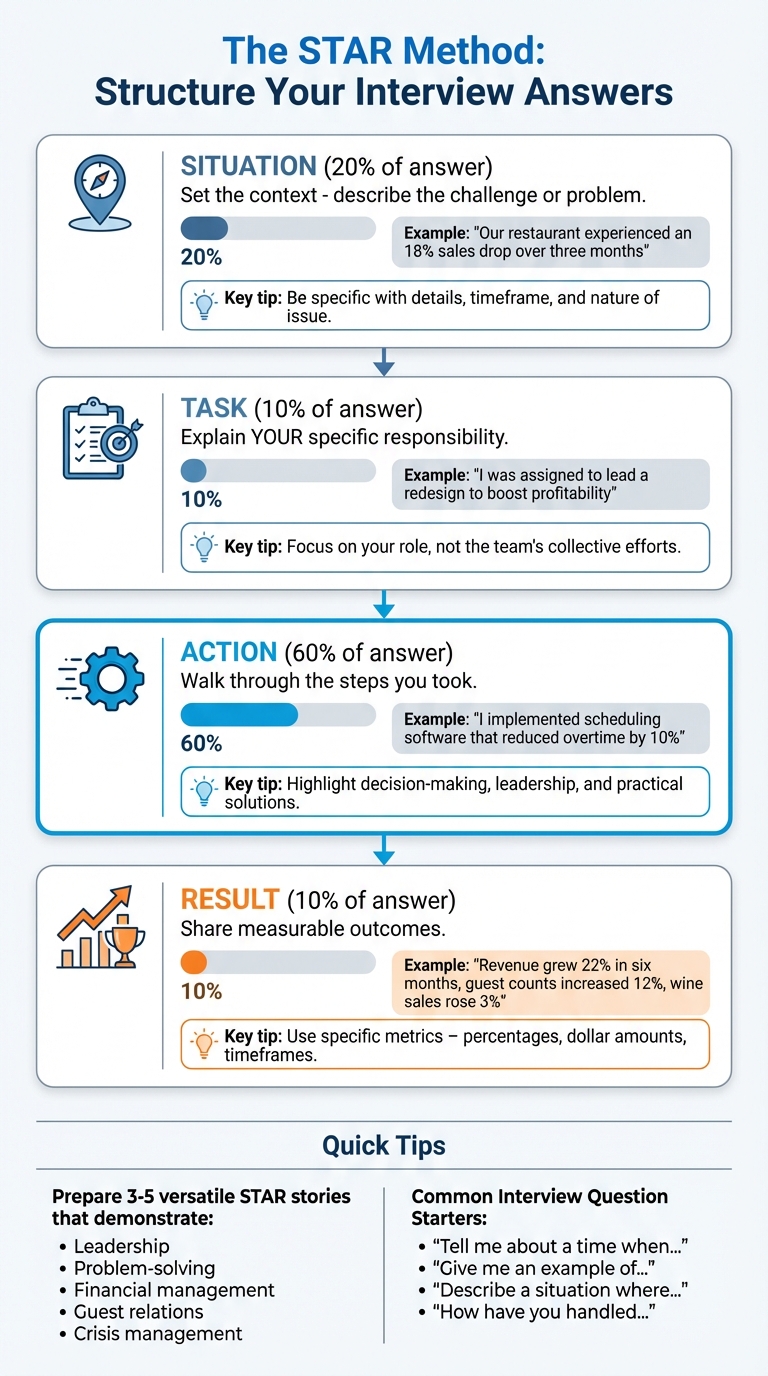
STAR Method Framework for Interview Answers
Answering Behavioral Interview Questions Using the STAR Method
Understanding Each Part of the STAR Method
The STAR method breaks your response into four clear parts – Situation, Task, Action, and Result – making it easier for interviewers to follow your story and remember your key points. Let’s dive into each step.
Situation: Setting the Context
Begin by describing the challenge or problem you faced. Provide specific details like the location, timeframe, and the nature of the issue. For example:
"Our restaurant experienced an 18% sales drop over three months."
This immediately sets the stage and conveys the gravity of the situation. Be precise – mention if it was a staffing shortage during a busy holiday, a sudden equipment breakdown during peak hours, or a recurring customer service issue. The more vivid and specific your description, the better it highlights your problem-solving abilities in restaurant management.
Task: Explaining Your Responsibility
After outlining the situation, explain your specific role in addressing the problem. This part is about your responsibilities, not the team’s collective efforts. As Suzanne Wiebe from Gecko Hospitality puts it:
"T – Task: Explain your specific responsibility in that scenario."
For instance, if you were tasked with addressing the sales decline, you might say:
"The general manager assigned me to lead a redesign aimed at increasing profitability."
This makes it clear that you were given a leadership role with direct accountability, showcasing your ability to take charge in operational challenges.
Action: Describing What You Did
Next, walk the interviewer through the steps you took to tackle the issue. Highlight your decision-making process, leadership skills, and actions. Did you reorganize the team, adjust scheduling, or introduce new tools? For example:
"I implemented scheduling software that reduced overtime by 10%."
Keep it concise and focused on your contributions. This part demonstrates your ability to execute practical solutions and handle pressure in a fast-paced restaurant environment.
Result: Sharing the Outcome
Wrap up with the results of your efforts, using measurable outcomes to illustrate your success. Include metrics like percentages, revenue growth, or customer satisfaction improvements. For example, in the restaurant redesign scenario, you could highlight achievements such as:
"Guest counts increased by 12%, wine sales rose by 3%, total revenue grew by 22%, and investor profit margins improved by 4% within six months."
Even if the results weren’t perfect, mention key takeaways or lessons learned. As Gecko Hospitality points out:
"Recruiters understand industry-specific metrics – occupancy rates, RevPAR, COGS, labor efficiency – so they’ll coach you on how to connect your results to what hiring managers actually measure."
You can also include other metrics, like reduced food costs, higher customer satisfaction scores, or achieving zero negative reviews on platforms like TripAdvisor. These details reinforce your ability to deliver results and make a lasting impact in restaurant management.
Preparing Your STAR Stories for Restaurant Interviews
When preparing for restaurant management interviews, it’s crucial to align your STAR (Situation, Task, Action, Result) stories with the job description. This helps you demonstrate how your past experiences meet the employer’s needs.
Finding Key Skills in Job Descriptions
Start by thoroughly reviewing the job posting to pinpoint the most important skills and qualities the employer is looking for. Pay attention to the top five to seven abilities that show up repeatedly, such as leadership, financial management, operations, guest relations, or crisis management. Look for action verbs like "reduce costs", "improve guest satisfaction", or "manage staff scheduling". Use these keywords as a guide when crafting your STAR examples, ensuring that each skill you highlight is supported by a measurable story.
Selecting the Right Work Examples
Once you’ve identified the key skills, choose examples from your career that directly tie to them. Focus on situations where you tackled challenges like staffing shortages, declining sales, or persistent customer complaints. The best examples showcase your ability to solve problems, lead under pressure, collaborate effectively, and adapt to changing circumstances. Select stories that are highly relevant to the role you’re pursuing to make a stronger impact.
Using Numbers to Show Results
Quantifiable results make your examples more compelling. For instance, you might say, "I introduced 7shifts scheduling software, cutting overtime by 10%". Use clear U.S. formatting for numbers – dollar amounts like $15,000, percentages like 22%, and timeframes such as "within six months." Whether you’re discussing reduced food waste, labor costs as a percentage of revenue, increased average check size, or higher customer satisfaction scores, specific numbers provide concrete proof of your achievements. Hiring managers appreciate metrics like COGS (Cost of Goods Sold) or labor efficiency, so frame your results in terms they understand.
With these tailored STAR stories, you’ll be well-prepared to deliver impactful answers in your interview.
sbb-itb-306cd44
Delivering STAR Responses During the Interview
Once you’ve crafted your STAR stories, the next step is delivering them with confidence during the interview. How you present your answers is just as important as the content itself. Your goal is to come across as self-assured and focused while showcasing the skills that make you the ideal candidate for the job.
Identifying Behavioral Interview Questions
Behavioral questions are easy to recognize once you know what to look for. They often begin with phrases like "Tell me about a time when…", "Give me an example of…", "Describe a situation where…", or "How have you handled…". These types of questions are designed to draw out specific, real-life examples of how you’ve handled situations in the past. For restaurant managers, typical questions might include, "Tell me about a time you dealt with an angry customer" or "Give me an example of how you reduced labor costs." When you hear a behavioral question, match it with the STAR story that best demonstrates the skill being evaluated. Once you’ve identified the right story, keep your response concise and relevant.
Keeping Your Answers Clear and Brief
The STAR method is a great way to keep your answers organized, but it’s just as important to manage the length of your response. A good rule of thumb is to allocate your answer as 20% Situation, 10% Task, 60% Action, and 10% Result. Focus primarily on the Action – this is where you highlight your skills and decision-making process. Describe the Situation in one or two sentences, and always use "I" statements to clarify your personal contributions. Suzanne Wiebe from Gecko Hospitality offers this advice:
"The STAR format is powerful, but it requires discipline. Avoid over-explaining or criticizing past employers. Stick to facts and keep your tone solution-oriented. Every story should have a clear arc: challenge, action, result."
By keeping your answers structured and to the point, you’ll leave a stronger impression on your interviewer.
Demonstrating Leadership and Operations Skills
For roles in restaurant management, interviews often focus on leadership, problem-solving, and operational abilities under pressure. Use your STAR responses to demonstrate how you’ve applied critical thinking to handle challenges, communicated effectively in high-stress situations, and implemented strategies that improved guest satisfaction and profitability. For example, when discussing a staffing crisis, highlight how you reassigned roles to maintain service standards despite the pressure. If asked about cost control, explain how you analyzed food waste, introduced new procedures, and tracked the financial results of your efforts. These examples showcase not only your ability to lead but also your focus on driving improvements.
Advanced STAR Techniques for Restaurant Managers
Going beyond the basics of the STAR method can set you apart in an interview. Let’s explore some advanced strategies to elevate your responses.
Using One Story to Highlight Multiple Skills
The best STAR stories aren’t one-dimensional – they showcase several skills at once. When preparing for your interview, think of situations where you tackled multiple challenges or responsibilities. A single scenario can highlight your leadership, problem-solving abilities, financial expertise, and customer service skills. It’s all about tailoring the story to the question you’re asked.
Take, for instance, a restaurant redesign project. This could demonstrate critical thinking (evaluating guest feedback), teamwork (coordinating with various departments), leadership (overseeing implementation), and measurable results (boosting revenue and profitability). When crafting your response, focus on the Action and Result parts. Share specific steps you took – like motivating your team or analyzing guest feedback – and back it up with numbers, such as increased guest satisfaction or improved profits. The key is flexibility: adapt your story to highlight different skills depending on the interviewer’s focus, rather than memorizing a rigid script.
This approach also helps you avoid common pitfalls when using the STAR method.
Avoiding Common STAR Mistakes
As you refine your storytelling, watch out for common STAR method errors. One major misstep is being too vague – don’t gloss over the details of what you did or how your actions made a difference. Another is overusing "we" instead of "I", which can obscure your personal contribution. And don’t forget to include measurable results, like percentages, dollar amounts, or specific metrics that reflect your impact on guest satisfaction, efficiency, or profitability.
Keep your answers concise. Overloading your response with unnecessary details can dilute your message. Stay solution-focused, and avoid speaking negatively about past employers – it can come across as unprofessional. If a situation didn’t turn out perfectly, emphasize what you learned and how it helped you grow. Lastly, make sure your examples are relevant, specific, and recent – ideally from the last five years and directly tied to the role you’re pursuing.
Practicing Your STAR Responses
Practicing your STAR responses aloud is crucial for sounding confident and natural. Try rehearsing over the phone or on video while maintaining eye contact and using notes sparingly as prompts.
Instead of memorizing word-for-word answers, prepare three to five versatile STAR stories that can be adapted to highlight different skills like leadership, communication, and work ethic. Focus on explaining how you achieved results – walk through your process, the reasoning behind your actions, and the tools or methods you used.
Mock interviews can be a great way to refine your delivery. Seek feedback from a career coach or recruiter to fine-tune your responses. You can also use AI-driven tools to analyze your pacing, identify filler words, and flag any areas for improvement. After each practice session, take a moment to reflect on what worked well and where you can improve. This iterative process will help you approach your interview with confidence and clarity.
Conclusion
The STAR method provides restaurant managers with a clear framework to present their experiences effectively during interviews. By organizing your responses into Situation, Task, Action, and Result, you can clearly demonstrate your ability to analyze challenges, lead teams, and deliver measurable results.
Behavioral interviews are designed to uncover how you perform in real-world scenarios. The STAR method aligns perfectly with the daily responsibilities of restaurant leaders – whether it’s addressing operational issues, staying composed under pressure, or improving guest experiences and profitability. Instead of simply listing achievements, this approach allows you to showcase your decision-making process and the impact of your actions.
To prepare, create three to five versatile examples that highlight a range of skills, such as crisis management, team leadership, and financial oversight. Pay close attention to explaining how you approached each situation – your thought process, the steps you took, and how it reflects industry best practices.
Most top candidates in behavioral interviews rely on the STAR method for a reason. It’s not about memorizing answers but about having a flexible structure that lets you adapt your stories to different questions while staying concise and focused. Mastering this technique helps you emphasize your achievements while also demonstrating your potential for growth.
In the fast-paced world of restaurant management, where quick thinking and strong leadership are critical, the STAR method can set you apart. With thoughtful preparation and confident storytelling, you can turn your interviews into powerful opportunities to highlight your leadership and the value you bring to the table.
FAQs
How can I adapt STAR examples to match a specific job description?
When crafting your STAR examples, align them with the skills and traits highlighted in the job description. Focus on showcasing experiences that reflect important qualities such as leadership, customer service, or problem-solving. Be sure to include measurable results that tie back to the role’s responsibilities.
For example, if team management is a core aspect of the job, select a STAR story where you led a team to success, resolved conflicts effectively, or streamlined processes to boost efficiency. By tailoring your examples this way, you clearly demonstrate how your background aligns with the needs of the position.
What mistakes should I avoid when using the STAR method in an interview?
When applying the STAR method in interviews, steer clear of these frequent missteps:
- Lacking specifics: Ensure each part of your STAR response includes clear, detailed examples to make your story stand out.
- Overloading your answer: Keep your responses concise and to the point, directly addressing the interviewer’s question.
- Shifting focus away from yourself: Emphasize your role and contributions rather than those of the team or others.
- Neglecting measurable outcomes: Whenever possible, include quantifiable results (e.g., "boosted sales by 15%" or "cut costs by 10%").
- Using unrelated examples: Choose stories that align with the role and showcase the skills the interviewer is seeking.
- Walking in unprepared: Have a few well-thought-out examples ready to avoid struggling for answers during the interview.
By sidestepping these errors, you’ll deliver responses that are clear, engaging, and leave a lasting impression.
What’s the best way to practice STAR interview responses?
To get the hang of STAR responses, start by creating short, focused stories that showcase your skills and experiences. Break them down into Situation, Task, Action, and Result, making sure your answers are straightforward and tailored to the job you’re aiming for.
Practice is key. Try mock interviews, record yourself, or work with a trusted friend or mentor. Pay attention to how you sound – your tone, pacing, and even your body language matter. Fine-tune your responses to keep them concise and impactful, highlighting what you did and the results you achieved. The more you practice, the more confident and prepared you’ll feel when it’s time for the real deal.