
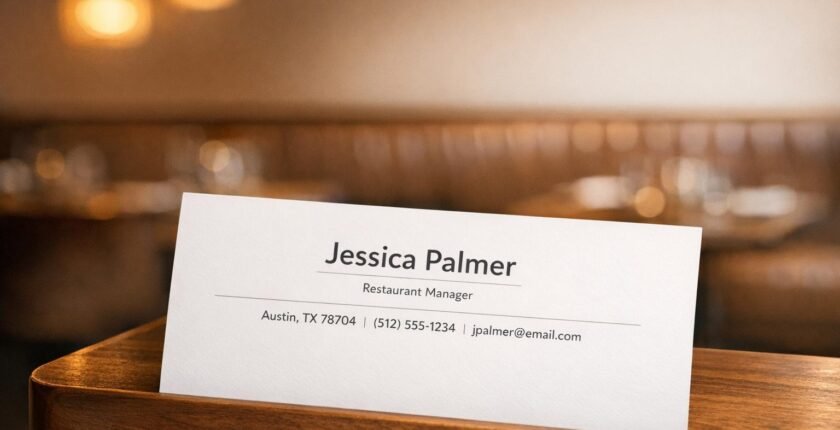
Should You Put Your Address on a Resume in 2026?
In 2026, including your full street address on a resume is no longer necessary. Instead, listing your city, state, and ZIP code is the standard. This approach ensures your resume meets hiring systems’ requirements while protecting your privacy. Here’s why:
- Privacy Concerns: Full addresses can expose you to identity theft and hiring biases.
- Modern Hiring Practices: Most communication happens digitally, and employers rarely need your full address.
- Applicant Tracking Systems (ATS): These systems use location filters based on city, state, and ZIP code to identify local candidates.
For restaurant manager roles, proximity matters, but sharing your general location is enough. Follow these restaurant manager resume header tips for your contact details:
Name | Phone | Email | City, State ZIP | LinkedIn URL.
Save your full address for later stages, like background checks, and focus on showcasing your skills and experience.
The Problem: Privacy Concerns and Changing Hiring Practices
Data Privacy and Identity Theft Risks
Including your home address on a resume might seem harmless, but it’s actually a piece of personally identifiable information (PII) that can put your privacy at risk. When you upload your resume to public job boards, you’re exposing sensitive details that could lead to identity theft or misuse.
Char-Lynn McClain, a Certified Personal & Professional Development Coach, highlights this risk:
"Your mailing address is considered ‘personal identification information,’ and the laws related to revealing a candidate’s sensitive personal information are complex".
She also points out another troubling issue:
"I have worked with employers who make assumptions about people who live in certain neighborhoods, going as far as using the ATS to screen for and filter out candidates with addresses in areas they are prejudiced against".
For restaurant managers, this is especially concerning. Sharing your address not only increases the risk of unauthorized access to your personal data but also leaves you vulnerable to biases in hiring systems. These challenges are further intensified by the growing reliance on automated hiring tools.
How ATS Systems Work in the Restaurant Industry
With privacy concerns reshaping hiring practices, Applicant Tracking Systems (ATS) have adapted to require less detailed location information. These systems no longer need a full street address to assess a candidate’s proximity to the workplace. By 2025, an estimated 98% of Fortune 500 companies were using ATS platforms to manage job applications.
In 2026, ATS tools rely on geo-filtering, focusing on city, state, and ZIP code to identify local candidates. For restaurant operators, this allows them to filter applicants within a specific radius – commonly 10 to 20 miles of the establishment. A 2025 report revealed that 43.4% of recruiters use location-based ATS filters to streamline candidate searches.
Megan Dias, a Career Services Coach at Parsity, explains why this approach is sufficient:
"The city and state are critical because, due to HR tax laws, companies need to ensure the candidate lives in a state aligned with their payroll policies".
For restaurant management roles, where being physically present is often non-negotiable, providing just your city and state is enough to meet these requirements. This approach not only satisfies ATS filters but also protects your personal information from unnecessary exposure.
sbb-itb-306cd44
Resume Standards for Restaurant Managers
What Hiring Managers Expect to See
If you’re aiming for a restaurant manager role, your contact details need to make it clear that you’re available locally. Your resume should include your full name, phone number (with area code), professional email address, city, state, ZIP code, and a link to your LinkedIn profile. All of this should appear in a single-line header.
For on-site positions like restaurant management, proximity to the workplace is often crucial. Adding your ZIP code ensures your resume passes ATS (Applicant Tracking System) geo-filters, which typically screen for candidates within a 10- to 20-mile radius of the location. This simple detail can make a big difference, as it confirms you’re in the area and ready to work.
These contact details also play a key role in how your resume is structured to perform well with ATS systems.
Current Resume Formatting Examples
Today’s restaurant manager resumes favor a single-line contact section to save space for highlighting your work experience and achievements. The traditional multi-line address block is outdated. Instead, here’s the modern format:
Name | Phone | Email | City, State ZIP | LinkedIn URL.
If you’re in the process of relocating for a management role, it’s important to indicate this clearly. The standard way to do so is by including a note like: "Relocating to [City, State] in [Month/Year]" directly in your contact header. This demonstrates your commitment to the move and helps avoid being filtered out automatically.
One critical tip: never place your contact details in headers or footers. ATS systems often can’t read information in those areas, which could lead to your application being overlooked. In fact, 88% of hiring managers say that qualified candidates are frequently eliminated by ATS systems due to formatting errors.
How to Write an ATS-Friendly Resume in 2026
Pros and Cons of Including Your Address
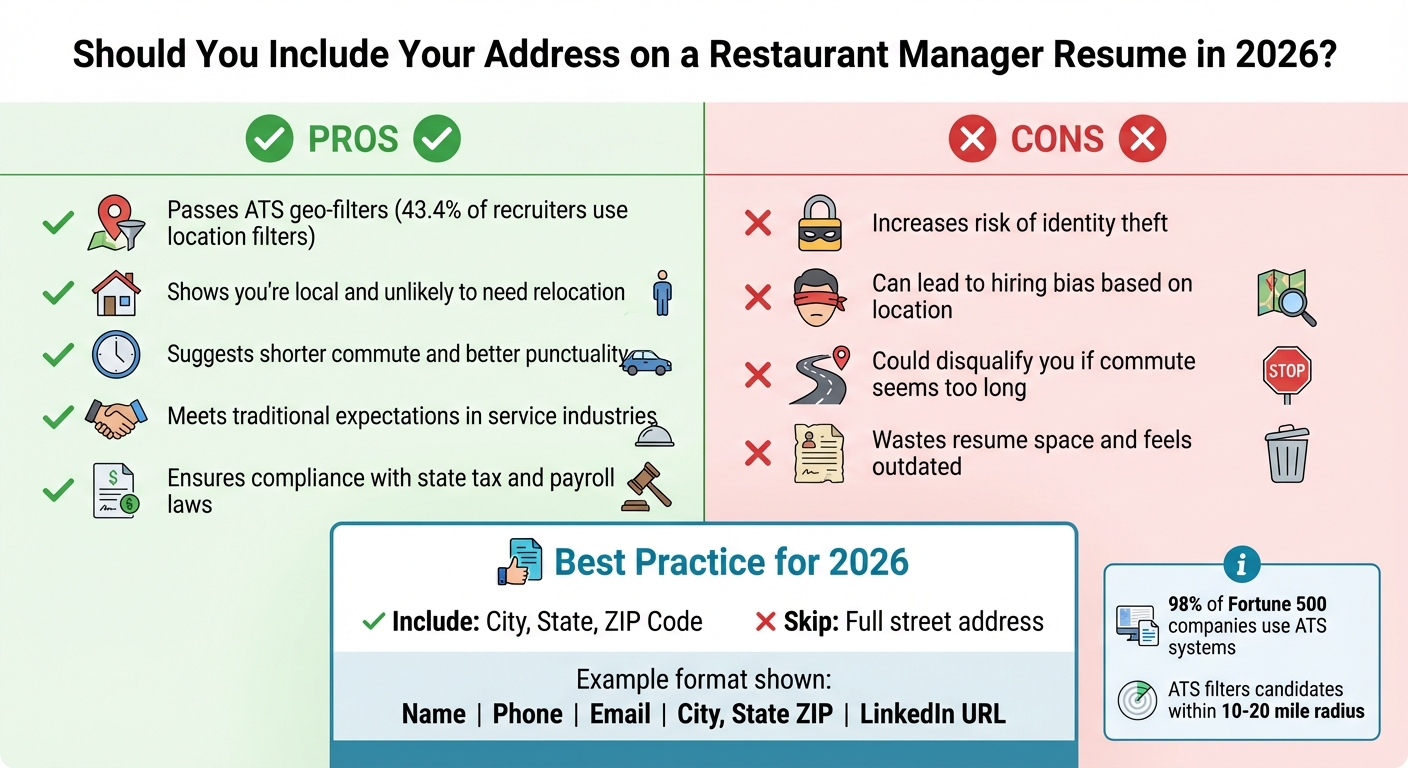
Resume Address Format Guide for Restaurant Managers 2026
Deciding whether to include your address on a restaurant manager resume comes down to weighing the benefits of signaling proximity against protecting your privacy.
There are clear advantages. Including your address can help your resume pass ATS (Applicant Tracking System) geo-filters, which many recruiters use to prioritize local candidates. It also shows you’re nearby and unlikely to require relocation, making you a safer bet for employers worried about attendance. As career coach Emily Liou puts it: "Local candidates are the safest candidates". Additionally, listing your city and ZIP code ensures compliance with tax laws. HR consultant Megan Dias explains: "The city and state are critical because, due to HR tax laws, companies need to ensure the candidate lives in a state aligned with their payroll policies".
However, there are downsides. Sharing your full address increases the risk of identity theft and exposes you to potential location-based hiring bias. Career consultant Char-Lynn McClain cautions: "I have worked with employers who make assumptions about people who live in certain neighborhoods, going as far as using the ATS to screen for and filter out candidates with addresses in areas they are prejudiced against". On top of that, including a full street address can waste valuable resume space and feel outdated in today’s digital-first hiring environment.
Here’s a quick breakdown of the pros and cons:
Comparison Table: Advantages vs. Disadvantages
| Pros | Cons |
|---|---|
| Helps pass ATS geo-filters used by 43.4% of recruiters | Increases risk of identity theft |
| Shows you’re local and unlikely to need relocation | Can lead to hiring bias based on location |
| Suggests a shorter commute and better punctuality | Could disqualify you if the commute seems too long |
| Meets traditional expectations in service industries | Wastes resume space and feels outdated |
| Ensures compliance with state tax and payroll laws |
The best approach? Skip the street address altogether. Instead, simply list your city, state, and ZIP code. This strikes a balance – giving employers the location details they need while safeguarding your personal information and keeping your resume streamlined.
Solution: How to Format Your Resume in 2026
The Best Contact Information Format
Your resume header should be simple, clear, and mindful of your privacy. Include your full name, a professional email address (steer clear of nicknames), a phone number with area code, and your city, state, and ZIP code. Don’t forget to add your LinkedIn profile URL – this gives recruiters a verified, professional point of contact. Avoid listing your full street address or apartment number.
This format ensures recruiters have the key details they need, like your general location for payroll and availability, while keeping overly personal information private. As career consultant Dilara Casey explains:
"This is not the Census Bureau. […] You’re applying for a job at a company. They just need to know if you’re in town in case the job’s on-site."
If you’re planning to relocate, include a note like "Relocating to Miami, FL in June 2026" or "Open to Relocation" below your current location. This ensures you show up in local applicant tracking system (ATS) searches – something 43.4% of recruiters use to filter candidates by geography. For remote or multi-location roles, you can add your time zone (e.g., "Based in Central Time Zone") to help employers align schedules more easily.
Make sure your contact details are included in the main body text to ensure they’re ATS-friendly. Once your header is polished, you’ll be ready to use tools like RR Guy to focus on your local job search.
Using RR Guy for Location-Based Job Searches
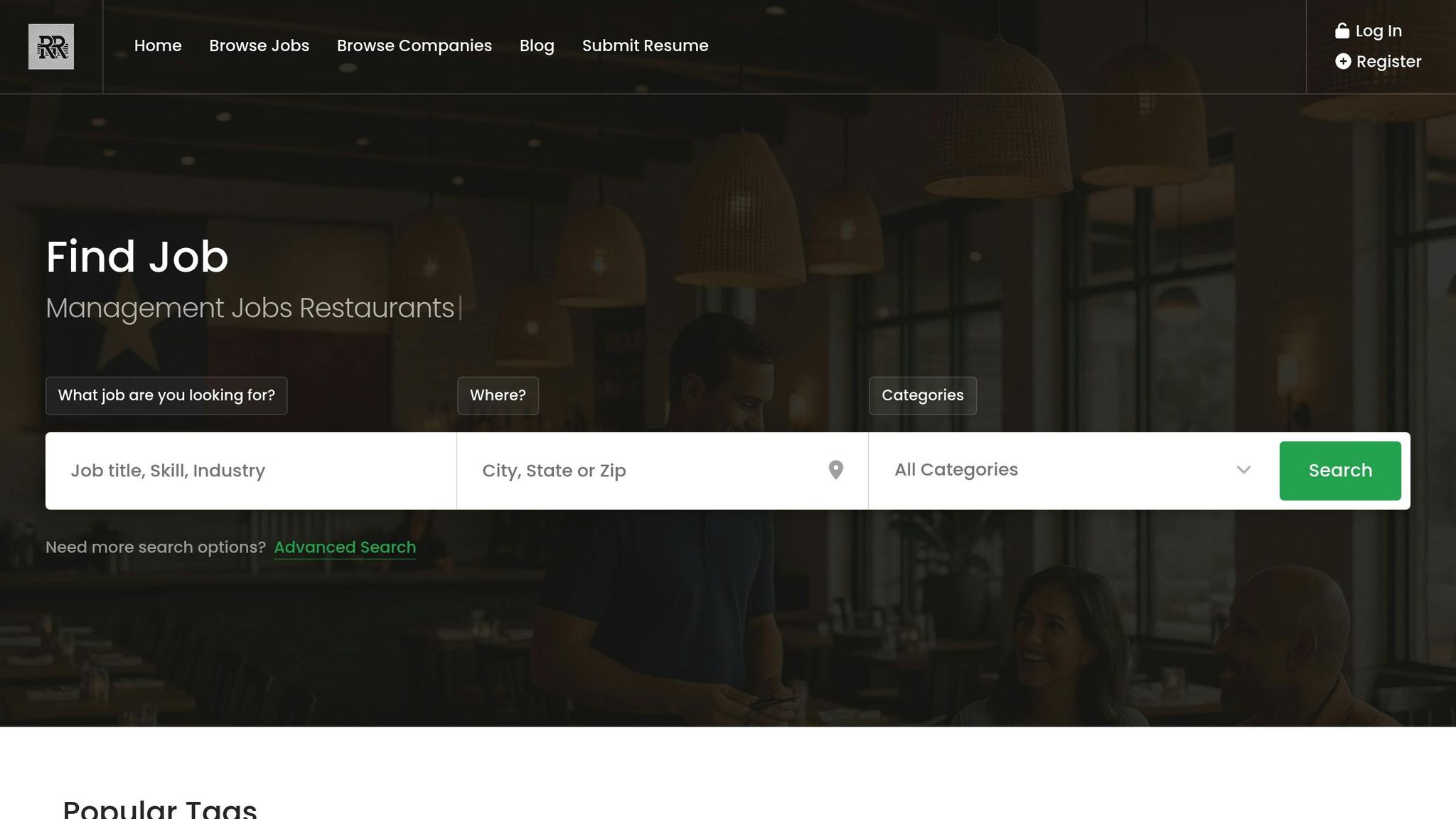
RR Guy’s location-based search tools are perfect for finding restaurant management roles by city, state, or even dining category. Whether you’re targeting casual dining, fast casual, or fine dining, these tools help you narrow your search without sharing personal details upfront. You can also set up job alerts for specific areas, so you’ll be notified when openings pop up in your desired location.
This method strikes a balance between privacy and precision, catering to the specific needs of local restaurant management positions. You’ll keep your resume private until you decide to apply, ensuring your location details are only shared with employers you select. Plus, RR Guy’s candidate dashboard makes it easy to manage your applications and track responses in one place, keeping your job search organized and secure.
Conclusion: Key Takeaways for Restaurant Managers
Modern hiring practices are shifting, and it’s time to rethink how you present your contact details on your resume. Including your city, state, and ZIP code – instead of your full street address – is now the norm. This updated format not only protects your personal information from identity theft and data breaches but also aligns with recruiters’ use of ATS geo-filtering to find local candidates. For on-site restaurant management roles, being local is key, as hiring managers often prefer candidates with a manageable commute to reduce turnover risks. By sharing your general location, you show you’re within a reasonable distance without risking privacy or facing location-based bias.
To support this streamlined approach, tools like RR Guy’s location-based search features allow you to focus on restaurant management opportunities by city, state, or dining category – all while keeping your personal information secure until you’re ready to apply. With helpful features like job alerts and an organized candidate dashboard, you can handle your job hunt efficiently and discreetly.
Save your full address for the final stages, such as background checks or onboarding after you’ve secured an offer. Until then, let your skills and experience do the talking.
FAQs
Will leaving off my street address hurt my chances?
In 2026, leaving your full street address off your resume is unlikely to impact your job prospects. Employers are typically more interested in knowing your city and state or your general location, especially for remote positions. Since hiring processes rarely involve physical mail anymore, providing your complete address is often unnecessary and could even pose privacy risks.
What should I list if I’m relocating soon?
If you’re planning to relocate, include your new city and state on your resume rather than your full address. You can also highlight your relocation plans in your resume or cover letter. This keeps your application focused and protects your privacy.
When should I share my full address with an employer?
When applying for a job, only share your full address if the role specifically demands local candidates, requires in-person attendance (like on-site jobs or government positions), or if the employer explicitly requests it. In most cases, simply listing your city and state is enough and is a smarter choice to maintain your privacy.