

Resume Mistakes That Get Restaurant Pros Rejected Fast
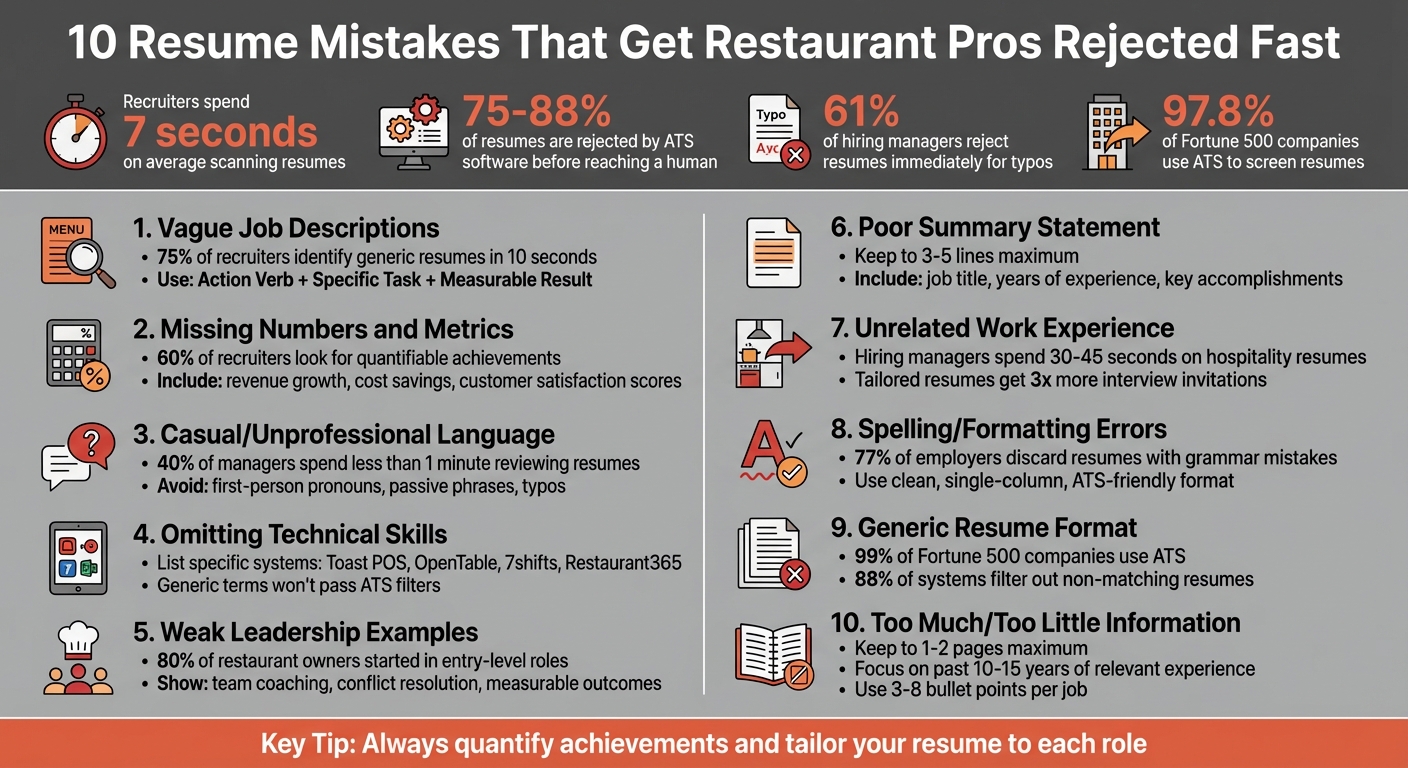
Recruiters spend 7 seconds on average scanning resumes, and 75%–88% of resumes are rejected by ATS software before reaching a human. For restaurant managers, even minor errors can cost you the job. Here are 10 common resume mistakes to avoid:
- Vague Job Descriptions: Replace generic tasks with specific achievements, using numbers to show impact (e.g., "Reduced turnover by 40%").
- Missing Metrics: Add measurable results like revenue growth, cost savings, or team performance.
- Casual or Unprofessional Language: Avoid typos, first-person pronouns, and passive phrases. Use professional formatting and headers and action verbs.
- Omitting Technical Skills: List software like Toast POS or OpenTable to pass ATS filters.
- Weak Leadership Examples: Highlight how you led teams, solved conflicts, or improved operations.
- Poor Summary Statement: Use concise, results-driven summaries tailored to the job.
- Unrelated Work Experience: Focus on relevant restaurant roles; omit unrelated or outdated jobs unless transferable.
- Spelling/Formatting Errors: Stick to clean, ATS-friendly formats and double-check for typos.
- Generic Resume Format: Tailor your resume to the job description and include relevant keywords.
- Too Much or Too Little Information: Keep it focused, concise, and limited to 1–2 pages.
Key Tip: Always quantify your achievements and tailor your resume to the role. With ATS screening most applications, precision and relevance are critical to standing out.
10 Resume Mistakes Restaurant Managers Must Avoid
Building a Restaurant Manager Resume? Here Are 4 Things You Should Leave Out
sbb-itb-306cd44
1. Using Vague Job Descriptions
Your resume should highlight your achievements, not just list generic job duties. Yet, 75% of recruiters can identify a generic, uninspired resume within the first 10 seconds of looking at it. When you write phrases like "managed daily operations" or "supervised staff", you’re essentially describing what any restaurant manager does – not what makes you stand out.
"Most restaurant manager resumes fail because they read like job descriptions instead of achievement stories." – The Interview Guys
Phrases such as "responsible for inventory" or "handled guest complaints" not only lack specificity but also fail to include the keywords that Applicant Tracking Systems (ATS) are programmed to detect. Considering that 97.8% of Fortune 500 companies, including big names like Chipotle and Olive Garden, rely on ATS to screen resumes, vague descriptions might mean your application never reaches a human recruiter.
Here’s how to fix it: adopt the Action Verb + Specific Task + Measurable Result formula. For example:
- Instead of saying "managed restaurant staff", try: "Led a team of 28 staff members, reducing turnover by 40% through enhanced training programs."
- Replace "worked with budgets" with: "Managed inventory and vendor relationships, achieving a 12% reduction in costs".
When you write something like "Reduced food waste by 22% by implementing a new inventory tracking system", you’re showcasing your ability to cut costs. Or when you say "Processed an average of 80 check-ins/check-outs daily during peak season", you’re giving recruiters a clear picture of the scale of operations you can handle. Including numbers makes your accomplishments tangible and credible, which is exactly what 60% of recruiters look for before considering a candidate for an interview.
Up next: discover how incorporating precise metrics can take your resume to the next level.
2. Missing Numbers and Metrics
Numbers can turn your resume from a list of duties into proof of real achievements. Recruiters spend an average of 7.4 seconds skimming resumes, so a line like "managed restaurant operations" doesn’t stand out. But something like "increased quarterly sales by 32% ($450,000 to $594,000) through menu engineering" grabs attention and shows you understand the business side of hospitality.
"Numbers help recruiters understand the scope and scale of your contributions." – scale.jobs
Restaurant owners and hiring managers think in terms of profits, costs, and customer satisfaction. A statement like "reduced staff turnover by 40% through implementation of a new recognition program" speaks directly to those priorities. These specific metrics not only make your achievements stand out but also add credibility – especially since 75% to 88% of resumes are rejected by ATS systems before they ever reach a person.
What if you don’t have exact numbers? Use estimates or data from past performance reviews, sales reports, or scheduling records. If precise figures aren’t available, quantify the scope of your work instead. For example, mention the size of your team, the number of covers served during peak hours, or the square footage you managed. Even ranges like "managed 15-20 staff members" or "approximately 80 check-ins daily during peak season" give recruiters a clearer picture of your responsibilities.
Focus on these five impactful areas to highlight your contributions:
- Revenue growth: Sales increases, revenue per seat
- Cost savings: Reduced food waste, improved labor cost percentages
- Customer satisfaction: Higher review scores, improved Net Promoter Scores
- Team performance: Retention rates, lower turnover
- Operational efficiency: Faster table turns, shorter wait times
3. Writing in Casual or Unprofessional Language
Your resume is more than just a list of jobs – it’s a professional document that showcases your leadership and communication skills. Unfortunately, many restaurant managers miss the mark by using casual language. Did you know that 61% of hiring managers reject resumes immediately if they find typos or grammatical mistakes? And 40% of them spend less than a minute reviewing a resume. That’s how little time you have to make a strong impression.
To avoid getting dismissed right away, steer clear of casual language. A common mistake is overusing first-person pronouns like "I", "me", or "my." Instead of writing, "I managed a team of 15 servers", simplify it to "Managed team of 15 servers during peak dinner service". This approach not only sounds more professional but also directs attention to your accomplishments.
Another area to watch for is passive language. Phrases like "responsible for", "tasked with", or "duties included" tend to dilute the impact of your achievements. Replace these with powerful action verbs such as "spearheaded", "streamlined", "negotiated", or "revamped." For example, instead of saying, "Responsible for handling customer complaints", try, "Resolved 95% of guest concerns on-site, increasing satisfaction scores by 15%". Strong, precise language like this helps highlight your results and contributions.
Even your contact information needs to reflect professionalism. Email addresses like partyboy2024@email.com or ChiefsFanForever@email.com might seem harmless, but they can make you appear unprofessional. Stick to a clean format, such as FirstName.LastName@email.com. Also, double-check for spelling errors in critical terms like "Restaurant" and "Manager." Mistakes like "retaurant", "restaraunt", or "restaurant manger" can signal a lack of attention to detail.
Finally, avoid vague phrases like "dedicated professional" or "excellent customer service skills", especially if you don’t back them up with measurable results. Instead, focus on quantifiable achievements that demonstrate your expertise in the financial and operational aspects of restaurant management. This precision not only strengthens your resume but also positions you as a results-driven professional.
4. Leaving Out Technical Skills and Systems
Technical skills are just as crucial as measurable achievements when it comes to passing ATS filters. Leaving these out can result in your resume being automatically rejected. In fact, between 75% and 88% of resumes are dismissed by Applicant Tracking Systems (ATS) before they even reach a recruiter. This often happens because they lack specific keywords or technical terms the system is scanning for. For example, if you don’t mention the software you’ve used, hiring managers might assume you don’t have the necessary experience.
Be specific about the systems you’ve worked with. Instead of using vague terms like "POS experience", name the systems directly – such as Toast POS, Square, Micros, or Aloha. The same goes for reservation platforms like OpenTable, Resy, or SevenRooms, and scheduling tools such as 7shifts, Deputy, or Planday. ATS software is designed to pick up on these exact names, so generic terms won’t cut it.
"It tells employers you’ll integrate quickly without needing weeks of hand-holding." – Indeed Flex
Make your technical skills stand out by tying them to measurable outcomes. For instance, don’t just list "Restaurant365" on your resume. Instead, showcase its impact: "Reduced operational costs by 15% using Restaurant365 to manage budgets." Similarly, highlight achievements like a Restaurant Manager at Cheesecake Factory who implemented the Toast POS system across multiple locations (March 2018–June 2021), improving sales tracking and reporting efficiency by 15%.
To boost your ATS visibility, organize your technical skills into a clearly labeled section, such as "Technical Skills." This is where you can list restaurant software and tools, including back-of-house systems like inventory management platforms (MarketMan, Partender) and labor cost tools. For example, a Senior Restaurant Manager at Red Lobster used MarketMan’s predictive analytics (February 2017–November 2020) to cut food waste by 25% and optimize stock levels. These details show that you’re ready to hit the ground running and deliver results immediately.
5. Failing to Show Leadership Examples
Restaurant management isn’t just about checking off tasks – it’s about demonstrating leadership. Yet, too many resumes stick to generic lists of responsibilities instead of highlighting real achievements. Hiring managers want to see how you’ve coached teams, solved conflicts, and delivered measurable outcomes. Simply stating that you managed staff or oversaw operations won’t cut it.
"Employers aren’t just hiring experience; they’re hiring leadership behavior. Your résumé should reveal who you are as a thinker and mentor." – Suzanne Wiebe, Career Coach
To stand out, replace vague phrases like "responsible for" or "assisted with" with action-driven words such as led, developed, trained, or resolved. Then, back it up with numbers. For example, instead of saying "Managed customer service team", try: "Led a 5-person team, improving response time by 30%." Or instead of "Trained new employees", say: "Recruited, hired, and trained 12 staff members, reducing onboarding time from 3 weeks to 10 days." These kinds of details show not only your leadership but also your ability to keep the business running efficiently and profitably.
Progression within a company is another way to demonstrate leadership – even without a formal title. If you’ve moved from busser to server to lead server, highlight that trajectory. It shows that management recognized your potential. For instance, you might mention initiating a team incentive program for upselling that boosted sales by a specific percentage. Fun fact: 80% of today’s restaurant owners started in entry-level roles like busser, dishwasher, or server.
"A résumé or interview that demonstrates empathy, coaching, and clarity of communication is far more compelling than one focused only on operations." – Suzanne Wiebe, Career Coach
When listing leadership examples, tie each task to a clear business outcome – whether it’s faster service, reduced turnover, or higher revenue. Quantifiable results make your contributions impossible to ignore. Keep in mind that major chains like Chipotle, Olive Garden, and The Cheesecake Factory use Applicant Tracking Systems (ATS) to filter resumes. To get past these systems and impress hiring managers, make sure your leadership achievements are specific, measurable, and impactful.
Next, we’ll explore how to create a summary statement that ties all these strengths together.
6. Writing a Weak Summary Statement
Your summary statement is like your elevator pitch – it’s the first thing a hiring manager sees and your chance to grab their attention. Unfortunately, vague phrases like "hardworking team player" don’t say much about what makes you stand out.
"A resume isn’t an exhaustive work history – it’s a strategic marketing document." – Resume.AI
Too often, summaries sound more like a list of job duties than a showcase of achievements. A phrase like "experienced in restaurant management" doesn’t give hiring managers much to work with. What they really want to know is: Who are you as a professional? Where have you worked? And what measurable impact have you made? A strong summary should include your job title, years of experience, the type of establishment you’ve managed (like fine dining or fast-casual), and a couple of key accomplishments – such as "increased annual revenue by 15%" or "cut labor costs by 10%".
If you’re applying to major chains like Chipotle or The Cheesecake Factory, remember that many use ATS (Applicant Tracking System) software to scan resumes. This means your summary needs to include exact keywords from the job posting. For instance, if the listing mentions "P&L management", don’t replace it with "budget oversight" – stick to the specified terms.
Keep your summary brief – three to five lines at most. Use powerful action verbs like "spearheaded", "streamlined", or "revamped" instead of weaker phrases like "responsible for".
Here’s an example of a strong summary:
"Restaurant General Manager with 8+ years’ experience in high-volume casual dining. Increased annual revenue by 15% and reduced labor costs by 10% through strategic operational enhancements."
This example is concise, specific, and packed with measurable achievements – exactly what hiring managers want to see.
Now, let’s look at how including irrelevant work history can weaken your resume’s overall impact.
7. Including Unrelated Work Experience
A restaurant management resume should ideally stay within one to two pages. Why? Hiring managers typically spend just 30-45 seconds reviewing hospitality resumes before deciding whether to move forward or not. In such a short window, every line on your resume needs to work hard to highlight your restaurant management skills.
"The goal is not to create the longest employment history possible but rather to paint a picture of why you’re the candidate for the job." – Michelle Gaba, Career Advice Expert, Goodwin Recruiting
Including unrelated work experience – like retail or banking jobs from years ago – takes up space that could be used to emphasize your leadership in restaurant operations. These roles don’t showcase key qualifications like managing profit and loss, leading teams, or handling high-volume service. In fact, 88% of resumes are rejected because of common mistakes like including irrelevant details, which can weaken your professional story. Recruiters don’t want to sift through pages of unrelated history. They’re looking for a clear, focused narrative that demonstrates your growth in hospitality leadership.
There is, however, one exception. If you’re currently in an unrelated role or need to address an employment gap, include that experience – but keep it concise. Highlight transferable skills like customer service, team management, or inventory oversight. For instance, if you managed a retail team, you could emphasize supervising staff and achieving sales targets – skills that align closely with restaurant operations.
Tailoring your resume to the specific job you’re applying for can make a big difference. In fact, candidates who customize their resumes see up to 3x more interview invitations compared to those who stick with a generic version. Prioritize the experience that proves you’re ready for the role and cut out anything that doesn’t add value. Up next: how formatting issues can further affect your resume’s impact.
8. Making Spelling and Formatting Errors
In the world of restaurant management, precision is a direct reflection of your ability to maintain operational excellence. Even small mistakes, like a typo, can derail your chances before a hiring manager even gets to your qualifications. It’s telling that 61% of hiring managers say typos lead to immediate rejection, and 77% of employers discard resumes with spelling or grammar mistakes. For roles that demand attention to detail, such as restaurant management, these errors can come across as unprofessional.
The most damaging errors are often the simplest. Misspelling your job title – writing "retaurant manager", "restaraunt manager", "restraunt manager", or "restaurant manger" – can instantly hurt your credibility. Spell-check tools might not catch errors like "manger", as it’s a correctly spelled word in the wrong context. Other common issues include inconsistent date formats (like "06/2024" vs. "June 2024"), inconsistent capitalization, and using non–U.S. English spellings such as "optimise" instead of "optimize" when applying for U.S.-based positions.
"Just one grammatical error in your resume could lead to a hiring manager passing it over, despite your outstanding, relevant experience in your field." – Joe Rice, JDI Search
Formatting issues can be just as damaging as spelling mistakes, especially when it comes to Applicant Tracking Systems (ATS). A staggering 75% of resumes are rejected by ATS software before they even reach a human reviewer, often due to formatting problems. Multi-column layouts, tables, text boxes, and graphics can confuse the software, leading to scrambled or incomplete information. Even placing contact details in the header or footer is risky, as many ATS programs fail to read those sections. Additionally, using creative section titles like "My Journey" or "Highlights" can disrupt the categorization of your experience.
The fix is straightforward. Stick to a clean, single-column format with standard fonts like Arial or Calibri (10–12pt). Use conventional section headers such as "Work Experience" and "Skills." Save your resume with a professional file name, such as "FirstName-LastName-Resume.pdf", instead of something generic like "Resume.pdf". Proofread your resume carefully, ask a colleague to review it, read it both silently and aloud, and ensure consistent date formatting (MM/YYYY) for clarity. These small steps can make a big difference in ensuring your resume gets the attention it deserves.
9. Using a Generic Resume Format
Using a one-size-fits-all resume might seem like a time-saver, but it’s one of the quickest ways to miss out on an interview. While it may feel efficient to send the same resume to every restaurant job, it’s not effective – especially when 99% of Fortune 500 companies rely on Applicant Tracking Systems (ATS) to filter applications. A generic resume often fails to make it past these systems, let alone impress a hiring manager.
The issue with generic formats isn’t just about ATS compatibility. Many of these templates include flashy layouts with graphics, tables, or multi-column designs that confuse automated systems. They also tend to lack the specific keywords that hiring systems look for. In fact, 88% of employers say their systems filter out qualified candidates if resumes don’t match the job description word for word. For restaurant managers, this could mean missing critical terms like "P&L management", "inventory control", or even specific POS systems such as Toast or Micros.
"Most restaurant manager resumes fail because they read like job descriptions instead of achievement stories." – Mike Simpson, Career Expert, The Interview Guys
Customizing your resume shows attention to detail and genuine interest in the role. If you don’t tailor your resume to the specific restaurant – whether it’s fine dining, fast-casual, or high-volume – you risk appearing indifferent or unprepared. The fix is simple: personalize your resume by weaving in key terms from the job posting. Replace vague statements with results-driven examples. For instance, instead of saying "managed daily operations", use something like: "Reduced food waste by 22% by implementing new tracking protocols". Including the exact job title and relevant keywords can make you 10.6 times more likely to secure an interview.
Stick with a clean, single-column layout and use standard section headers like "Work Experience" and "Skills." Avoid overly creative labels or designs, and save your resume as a .docx or text-based PDF. Standard fonts like Arial or Calibri are best for readability and ATS compatibility. By focusing on both the content and the format of your resume, you’ll ensure it aligns with the needs of each restaurant position – and increase your chances of standing out to both ATS and hiring managers.
10. Adding Too Much or Too Little Information
Striking the right balance between detail and brevity is critical when crafting your resume. Recruiters spend an average of just 7.4 seconds scanning a resume to decide if it’s worth further consideration. This means every line on your resume needs to serve a purpose. Including too much – like every job you’ve had since high school – can obscure your most relevant accomplishments. On the flip side, providing too little information can leave hiring managers questioning your qualifications.
Think of your resume as a marketing tool, not a full autobiography. For example, if you’re an experienced restaurant manager, focus on the past 10–15 years of your career. Older roles and high school achievements should typically be left off, especially if they don’t add value to your current goals. Between 75% and 88% of resumes are rejected by Applicant Tracking Systems (ATS) before a human even sees them – often because they’re overloaded with irrelevant details. Keeping your content relevant and concise ensures your key achievements stand out.
Tailor your resume to highlight roles that showcase your expertise in restaurant management. Limit each job description to 3–8 bullet points focused on measurable accomplishments. If you have older or unrelated jobs, group them under an "Additional Experience" section to keep the focus on your most relevant work. Avoid dense paragraphs that are hard to skim, and skip outdated phrases like "References available upon request" or objective statements. Instead, use that space to feature specific, quantifiable successes.
For those with less than 10 years of experience, stick to a one-page resume. Even seasoned professionals should aim for no more than two pages. Include standard contact information – phone number, professional email, and LinkedIn profile – but leave out your full street address. With 98% of Fortune 500 companies, including restaurant giants like Chipotle and The Cheesecake Factory, using ATS software to filter candidates, a streamlined resume that emphasizes achievements and relevance is key to standing out.
How to Fix These Resume Mistakes
Now that we’ve highlighted common resume mistakes, let’s focus on turning your resume into a polished, results-driven document. Start by replacing passive phrases like "responsible for" or "tasked with" with dynamic action verbs. Words like "Spearheaded", "Streamlined", or "Negotiated" pack more punch and grab attention. Use the "Action + Metrics + Business Impact" formula to rewrite your bullet points. For instance, instead of saying you managed staff at Botanica Bistro, mention that you "Reduced staff turnover by 15% and food waste by 10% through mentorship programs and supplier contract negotiations, achieving a 12% total cost reduction" during your tenure starting in March 2019.
Adding specific metrics is another game-changer. Quantify your responsibilities to showcase your impact. For example, instead of vaguely mentioning that you supervised staff, detail the size of your team, the volume of work you handled, or the financial results of your efforts. Consider this example: At a 280-room Marriott property, a Front Office Manager "Implemented a training program that cut guest complaint response times by 40% and maintained a 92% satisfaction score – 7% above the brand standard". These details demonstrate both the scope of your role and the measurable outcomes you achieved.
Here’s a quick comparison to illustrate the difference between vague and impactful resume statements:
| Mistake Type | Vague/Passive | Clear/Metric-Driven |
|---|---|---|
| Missing Metrics | Managed restaurant staff and handled the daily schedules. | Led a team of 28 staff members, reducing turnover by 40% through training initiatives. |
| Vague Description | Responsible for front desk operations and guest complaints. | Supervised front desk at a 280-room property; cut complaint response time by 40%. |
| Casual Language | I helped the owner make more money by changing the menu. | Increased annual revenue by 15% through strategic menu engineering. |
| Missing Systems | Used the computer to check people in and out. | Expert user of Opera PMS and Toast POS systems, managing 80+ daily guest transactions. |
Another crucial step is tailoring your resume to the job description. Carefully analyze the posting for key terms and integrate them naturally into your experience. For example, if the job mentions "inventory management", use that exact phrase instead of "stock control." This method not only aligns your resume with the role but also helps you pass Applicant Tracking System (ATS) filters. Research shows that tailoring your resume to the job description can triple your chances of landing an interview.
Lastly, don’t overlook the importance of proofreading. Save your resume as "FirstName-LastName-Resume.pdf" to maintain its formatting. Avoid using tables, graphics, or text boxes, as they can confuse older ATS systems and lead to your application being rejected before it’s even reviewed. Remember, 61% of hiring managers discard resumes with typos immediately, and 77% of employers eliminate candidates for spelling or grammar mistakes. By following these steps, you’ll create a resume that stands out to both ATS software and hiring managers alike.
Conclusion
Your resume is often your first – and sometimes only – chance to make an impression. In the restaurant industry, a staggering 75% of resumes are filtered out by ATS software before a hiring manager even sees them. The difference between landing an interview and being overlooked often lies in avoiding the critical mistakes we’ve discussed.
Turn your resume into more than just a list of responsibilities – make it a story of measurable accomplishments. For instance, instead of saying, "responsible for staff", try something like, "Led a team of 28 staff members, reducing turnover by 40% through targeted training initiatives." Replace vague descriptions with impactful, results-focused statements that showcase your achievements. Highlight technical skills like Toast, OpenTable, or HotSchedules, and meticulously check for spelling or formatting errors. These changes not only help your resume pass ATS filters but also grab the attention of hiring managers.
Once your resume is polished, let your accomplishments pave the way to new opportunities. RR Guy specializes in matching restaurant management professionals with roles that align with their skills and experience. Whether you’re exploring casual dining, fine dining, or fast-casual options, you’ll find job listings tailored to the hospitality industry. By aligning your resume with these strategies, you’re setting yourself up for success in a competitive job market.
A resume that emphasizes leadership and proven results stands out in today’s restaurant industry. Focus on clarity, precision, and showcasing your value – and apply with confidence. The right opportunity is waiting.
FAQs
How do I add metrics if I don’t have exact numbers?
If you’re unsure of the exact numbers, using estimates or approximate metrics can still effectively showcase your achievements. For instance, you could say, "boosted sales by around 20%" or "led a team of approximately 15 people." Just be upfront about these being estimates if questioned. This method still highlights your contributions and the results of your efforts, even without precise figures.
What resume format is safest for ATS systems?
The best way to ensure your resume passes through ATS (Applicant Tracking System) software is to stick with a simple and clean format. Use standard fonts like Arial or Times New Roman, clearly labeled section headers, and save your file as a .docx – a format most ATS tools can easily read.
Avoid using fancy templates, images, or graphics, as these can confuse the system and cause your resume to be misread or skipped entirely. A straightforward design not only ensures compatibility with ATS but also makes it easier for hiring managers to review your qualifications.
Which restaurant software keywords should I include?
To make your resume stand out for a restaurant management position, it’s crucial to incorporate software-related keywords that align with Applicant Tracking Systems (ATS) and grab the attention of hiring managers. Include terms like POS systems, inventory management, staff scheduling, and financial reporting. Additionally, emphasize industry-specific skills such as menu planning, food safety certifications, and proficiency with customer service tools. Adjust these keywords to fit each job posting to maximize your chances of success.