

Executive Chef Resume: How to Show Leadership, Not Just Recipes
Crafting an executive chef resume goes beyond listing recipes and cooking techniques. To stand out, you need to highlight your leadership, team management, and operational achievements. Recruiters spend 7 seconds scanning resumes, so focus on measurable results like reducing food costs, managing large teams, or increasing revenue.
Key takeaways for building a strong executive chef resume:
- Show Leadership: Include examples of team management, training programs, and staff retention improvements.
- Quantify Achievements: Use specific metrics like "reduced food waste by 15%" or "oversaw $4.5M in annual operations."
- Balance Skills: Highlight both culinary expertise (e.g., menu engineering) and business acumen (e.g., P&L management).
- Tailor for ATS: Incorporate relevant keywords like "inventory control" and "vendor negotiation."
- Certifications Matter: Credentials like Certified Executive Chef (CEC) or ServSafe certification boost credibility.
Your resume should position you as a leader capable of driving results in both the kitchen and the business. Use action verbs, focus on measurable outcomes, and tailor your resume to the job description for maximum impact.
From Resume to Interview: Hospitality Hiring Experts Share Career-Boosting Tips
How to Write a Leadership-Focused Summary
When crafting your professional summary, focus on presenting yourself as a leader who understands the business side of restaurant management. This section is the heart of your resume – it’s where you showcase your ability to lead, not just cook. In just 2–3 sentences, highlight your years of experience, leadership strengths, and key operational achievements that align with the demands of the role.
Highlight Leadership and Operational Results
Your summary should position you as someone who drives measurable improvements in both financial and operational performance. Avoid generic statements and focus on specific impacts. For instance, Executive Chef Michael Rodriguez at Spruce in San Francisco led a 22-member kitchen team at a Michelin-starred restaurant generating $4.5M annually. Under his leadership, food costs dropped by 8%, and repeat patronage increased by 25% through innovative seasonal menus.
Leadership isn’t just about numbers – it’s also about people. Highlight your ability to manage and retain talent, especially in an industry known for high turnover. For example, Rachel Gomez at Oceanview Banquet Hall in Miami managed a 25-member team, executing events for up to 1,000 guests. Her menu customization strategies boosted repeat bookings by 20%. Demonstrating your ability to build and sustain strong teams can set you apart from other candidates.
Include Specific Numbers and Data
Numbers grab attention. Quantify your achievements wherever possible, whether it’s budget sizes, cost reductions, or revenue growth. Instead of saying "managed costs", be specific: "reduced food costs by 15% through strategic vendor renegotiation".
"Running a successful kitchen means more than just preparing delicious dishes. Highlight your financial proficiency by discussing the size of the budgets you’ve managed or the way you reduced food waste." – BeamJobs
Consider the example of Executive Chef Logan Ramirez at The Meridian Hotel & Spa in Chicago. Starting in April 2018, he led a 22-member culinary team to achieve a 19% increase in average guest spend and a 24% reduction in food waste within a year by implementing new inventory protocols. Metrics like these reflect strategic thinking and operational expertise – exactly what recruiters want to see. Use these accomplishments as a springboard for detailing your work experience in the next section.
Leadership Skills to Include on Your Resume
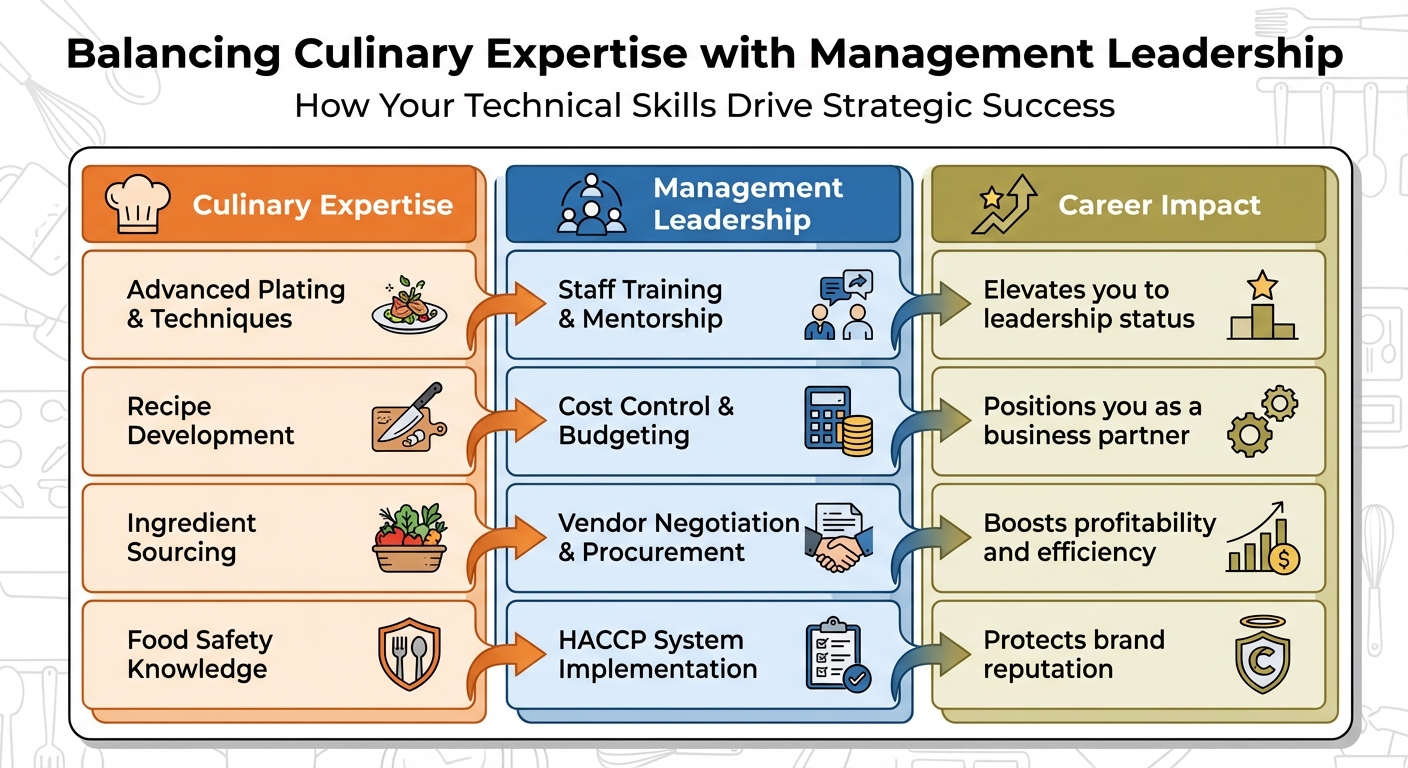
Executive Chef Resume: Balancing Culinary Skills with Management Leadership
Most Important Skills to List
When crafting your resume, focus on showing that you lead a kitchen with a business mindset, not just culinary talent. Highlight team leadership by showcasing your experience in training staff, managing schedules, and evaluating performance. For example, at The ABC Club, an executive chef oversaw 20 staff members across two restaurants, generating $3.8M in food and beverage sales in 2007 while maintaining food costs at 32% and labor expenses at 28%.
Demonstrating budget management and P&L responsibility is key to proving your grasp of the financial side of operations. Use specific terms like "vendor negotiation", "inventory control", and "cost reduction" to ensure your resume passes Applicant Tracking Systems during initial scans. When listing menu planning, connect it to measurable business outcomes. For instance, strategic use of seasonal ingredients increased repeat patronage by 25%.
Don’t forget to include compliance and safety leadership by mentioning HACCP certification and food safety management. These skills not only protect guests but also safeguard the establishment’s reputation. Other valuable skills to highlight include staff mentorship, optimizing workflows, and conducting performance evaluations. These demonstrate your ability to lead high-performing teams in demanding environments.
The challenge lies in integrating these skills without overshadowing your culinary expertise.
How to Balance Culinary and Management Skills
Striking the right balance between culinary and leadership skills is essential. Organize your resume into clear sections, such as "Technical/Culinary Skills" and "Leadership/Management Skills". This structure allows hiring managers to easily spot your management abilities without losing sight of your culinary foundation.
Connect your culinary expertise to business goals. For example, instead of just listing "recipe development", pair it with achievements like "menu engineering to maximize profitability." At Johnson Consulting in Rolling Meadows, IL, an executive chef’s menu development for a 5-star restaurant increased sales by 25%, reduced waste by 10%, and successfully managed a team of 25. Always link technical skills to measurable leadership outcomes, whether it’s cost control, revenue growth, or team development. This approach positions you as both a skilled chef and a strategic business leader.
Your resume should consistently reflect how your leadership drives operational success.
| Culinary Expertise | Management Leadership | Career Impact |
|---|---|---|
| Advanced Plating & Techniques | Staff Training & Mentorship | Elevates you to leadership status |
| Recipe Development | Cost Control & Budgeting | Positions you as a business partner |
| Ingredient Sourcing | Vendor Negotiation & Procurement | Boosts profitability and efficiency |
| Food Safety Knowledge | HACCP System Implementation | Protects brand reputation |
This breakdown emphasizes how your technical skills contribute to strategic success.
How to Write Your Work Experience Section
Use Strong Action Words and Measurable Outcomes
Your work experience section should highlight leadership and measurable results, going beyond just culinary skills. Start each bullet point with a strong action verb and back it up with clear metrics. Words like Led, Spearheaded, Directed, Implemented, and Negotiated convey authority and leadership.
For example, instead of saying, "managed kitchen staff", write something like: "Directed a 22-member culinary team overseeing $4.5M in annual operations." Similarly, if you’re showcasing cost control, include specific outcomes, such as: "Negotiated vendor contracts, reducing food costs by 12% while maintaining quality standards." Using action words like Cut, Reduced, Generated, or Negotiated can effectively highlight your business impact.
Take Executive Chef Samuel Martin at The Artisan Kitchen in New York as an example. He managed a 15-member team and achieved a 15% increase in customer retention while cutting food waste by 10% between January 2020 and July 2025.
When structuring your experience, include a brief description of your responsibilities, followed by bulleted achievements, listed in reverse-chronological order. Always focus on quantifiable results and align your accomplishments with the specific demands of the role you’re applying for.
Match Your Experience to Job Requirements
Tailor your resume to each job description by identifying key terms like "menu planning", "P&L management", "food safety", or "vendor negotiation." Incorporating these keywords into your bullet points can help your resume pass Applicant Tracking Systems and catch the hiring manager’s attention.
Adjust your experience based on the type of establishment. For example, if you’re applying to a high-volume banquet facility, emphasize your ability to manage large-scale events. Executive Chef Rachel Gomez at Oceanview Banquet Hall in Miami, for instance, supervised a 25-member team for events hosting up to 1,000 guests, driving a 20% increase in repeat bookings starting in April 2019.
For fine dining roles, focus on achievements like working with seasonal menus or locally sourced ingredients. Consider Executive Chef Michael Rodriguez at Michelin-starred Spruce in San Francisco, who oversaw $4.5M in annual revenue and increased repeat patronage by 25% from January 2018 to February 2026.
Always include details that show the scope of your operations – such as team size, seating capacity, annual revenue, or budget management. Replace generic task descriptions with leadership-driven outcomes. For example, instead of "prepared meals", write: "Trained and mentored a team in advanced culinary techniques."
"An executive chef resume needs to do more than list your past jobs and kitchen skills. It should reflect your leadership style, culinary vision, and ability to manage high-pressure environments with consistency and creativity." – Resume-Example.com
sbb-itb-306cd44
How to Prepare Your Resume for RR Guy
Add Keywords for Applicant Tracking Systems
Applicant Tracking Systems (ATS) are often the first hurdle your resume needs to clear. These systems scan for specific keywords before a recruiter even lays eyes on your application. To increase your chances, include terms from the job description, such as "executive chef," "cost control," "P&L management," and "team leadership." These keywords can help your resume make it past automated filters. Keep in mind that recruiters spend an average of seven seconds on an initial scan, so your resume needs to make an immediate impact.
Consider adding a Core Competencies section with 10–15 key skills. This should be a mix of technical abilities (like menu development, food safety, and inventory management) and leadership qualities (such as staff training, scheduling, and performance evaluation). For instance, if "vendor relations" is highlighted in the job posting, make sure to include your experience negotiating supplier contracts.
"Include your career target as the resume’s title (for instance: ‘Executive Chef’), immediately after your name and contact information." – Freddie Rohner, iHireChefs
Don’t forget to emphasize your expertise in culinary, financial, and operational areas. Mention specific software tools like Oracle MICROS, ChefTec, or TouchBistro to show your familiarity with industry technology. Stick to a clean, reverse-chronological format with standard headings and simple fonts. Avoid using photos, decorative borders, or flashy color schemes, as these can confuse ATS software.
How to Use RR Guy’s Job Search Tools
Once your resume is optimized for ATS, take advantage of RR Guy’s job search tools to refine your strategy. The platform’s category filters let you search by restaurant type – whether it’s casual dining, fine dining, fast casual, or banquet operations. Use these filters to target positions that align with your experience. Tailor your resume for each category by emphasizing accomplishments most relevant to that specific environment. For example, if you’re aiming for a fine dining role, focus on achievements that highlight your expertise in high-end culinary operations.
Set up job alerts to get notified about new executive chef openings in your preferred categories and locations. This allows you to apply quickly with a customized resume that mirrors the language and requirements in the job description. Take the time to review each posting, identify key technical and leadership skills, and refine your professional summary and skills section accordingly. The best part? RR Guy is free for candidates, giving you full access to browse listings, submit applications through your candidate dashboard, and track your progress – all at no cost.
Certifications and Education to Add
Certifications for Executive Chefs
Certifications showcase your skills and leadership in the culinary world. The Certified Executive Chef (CEC) credential from the American Culinary Federation (ACF) stands out as a top-tier qualification. It demonstrates expertise in areas like food safety, management, cost control, and nutrition. To apply, you’ll need at least 10 years of foodservice experience, including five years in a supervisory or management role. The application fee is $250, and renewal costs $150 every five years.
For those aiming even higher, the Certified Master Chef (CMC) is the pinnacle of ACF certifications. It requires at least 10 years of professional experience and five years as an executive chef. This elite certification is held by only a few chefs in the U.S. and involves passing an intense 8-day practical exam. The cost ranges from $2,000 to $3,000. If your focus leans more toward hospitality management, the Certified Food and Beverage Executive (CFBE) credential is an excellent choice. It emphasizes the business aspects of food service and is considered equivalent to an associate degree in the field.
Don’t overlook the ServSafe Food Protection Manager certification. It’s often legally required and demonstrates compliance with food safety regulations. When adding certifications to your resume, create a dedicated section to ensure they stand out to hiring managers and pass Applicant Tracking Systems (ATS). For high-profile credentials like the CEC, include them in your resume header alongside your name (e.g., "Jane Smith, CEC"). This instantly highlights your executive-level expertise.
Pair these certifications with a strong educational foundation to emphasize your leadership and operational skills.
Education and Training
Your educational background plays a critical role in demonstrating your ability to manage both the culinary and business sides of operations. A Bachelor of Science in Culinary Arts, Food Science, or Hospitality Management highlights your expertise in profit-and-loss management, HR responsibilities, and strategic planning. If you have a degree in Hospitality Management or Restaurant Operations Management, list it prominently – it underscores your understanding of the financial and administrative aspects of being an executive chef.
"If somebody goes to culinary school, it shows extra commitment and follow through…it’s a ‘gold star’ on their resume." – Josh Hasho, Executive Chef, Omni Hotels & Resorts
Always list your highest degree first, along with the institution’s name and location. While you can leave out graduation dates if you have extensive experience, the degree and school details are essential. If you’re pursuing a certification, mark it as "In Progress" and include the expected completion date. This demonstrates your commitment to continuous professional growth.
Your combination of education and specialized training reinforces your qualifications as a leader, aligning perfectly with the operational and strategic demands of an executive chef role.
Conclusion
Your resume should be a showcase of your leadership impact, telling a compelling story of how you’ve driven success in the kitchen and beyond. Focus on highlighting measurable outcomes – such as boosting revenue, cutting costs, improving staff retention, or streamlining operations – rather than listing routine culinary tasks.
"Writing an executive chef resume isn’t about listing everything you’ve ever done, it’s about showing the right experience, the right way." – Resume-example.com
Start with a professional summary that emphasizes your leadership track record. Use strong action verbs and include quantifiable achievements in your work experience section. Double-check your skills and certifications to ensure they reflect a solid mix of culinary expertise and operational leadership. Tailor your resume to each job description to navigate Applicant Tracking Systems effectively.
Take advantage of RR Guy to find tailored opportunities that align with your leadership profile. With job alerts and early access to roles, you’ll connect with employers before others even know about the opening. Best of all, the platform is free for candidates.
Present yourself as the strategic leader every restaurant needs. Make sure your resume demonstrates your ability to thrive under pressure, mentor teams, and deliver financial results. Every section should reinforce your leadership achievements and set you apart as the ideal candidate.
FAQs
How can I highlight leadership skills on my executive chef resume?
To make your executive chef resume stand out, highlight your leadership skills by showcasing how you’ve managed teams, improved operations, and delivered measurable results. For instance, you could include examples like: "Mentored a team of 15 kitchen staff, increasing productivity by 20%" or "Cut food costs by 12% through better inventory management and vendor negotiations."
Focus on leadership qualities such as team building, strategic planning, and problem-solving, and support these traits with specific accomplishments. Weave these details into your professional summary, skills section, and work experience to demonstrate your ability to lead and excel in high-pressure kitchen environments.
What metrics should I include on my executive chef resume to showcase my leadership and achievements?
To stand out as an executive chef, it’s essential to showcase your leadership and accomplishments with clear, measurable results. For instance, highlight how you’ve managed budgets effectively by reducing food waste or lowering labor costs. These details demonstrate your ability to handle financial responsibilities.
You can also emphasize achievements like boosting revenue, improving profit margins, increasing customer satisfaction scores, or leading successful initiatives such as launching new menus or optimizing kitchen workflows. Including specific figures – like "reduced food costs by 15%" or "generated an additional $50,000 in annual revenue" – adds weight to your contributions and makes your impact undeniable. These concrete examples can give you an edge in a competitive job market.
How can I make sure my resume gets through an Applicant Tracking System (ATS)?
To make sure your resume gets through an ATS (Applicant Tracking System), focus on aligning it with the job description. Include relevant keywords that match the role, but make sure they fit naturally within your descriptions of skills and accomplishments. Overloading your resume with keywords can work against you.
Stick to a clean and simple format – avoid using excessive graphics, tables, or unusual fonts, as these can confuse the system. Use standard section headings like Work Experience, Skills, and Education to ensure the ATS can categorize your details correctly.
By tailoring your resume to the job requirements and keeping the layout straightforward, you’ll increase the odds of catching both the system’s and the hiring manager’s attention.