
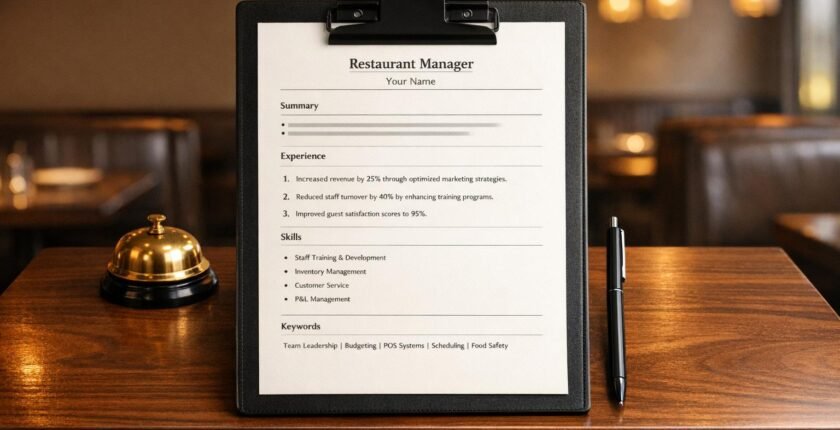
Restaurant Manager Resume: The 1-Page Format That Gets Interviews
Your restaurant manager resume has just 6–7 seconds to make an impression – and it needs to pass Applicant Tracking Systems (ATS) to even reach a recruiter. Here’s the solution: a one-page resume focused on measurable achievements, clean formatting, and tailored content.
Key Takeaways:
- Focus on results: Replace vague responsibilities with quantifiable achievements (e.g., "Reduced food waste by 22%, saving $18,000 annually").
- Optimize for ATS: Use standard headers, simple formatting, and keywords from job postings.
- Structure for impact: Include four sections – Contact Info & Summary, Work Experience, Skills & Certifications, and Education.
- Fine-tune formatting: Shrink margins, use clear fonts, and highlight key points with bold text.
- Tailor for the role: Highlight guest service for fine dining or efficiency for high-volume chains. Always match keywords to the job description.
With food service management roles growing by 9% through 2026, a concise, well-structured resume can help you stand out and land interviews.
How To Write A Restaurant Manager Resume? – Job Success Network
sbb-itb-306cd44
What to Include in Your Restaurant Manager Resume
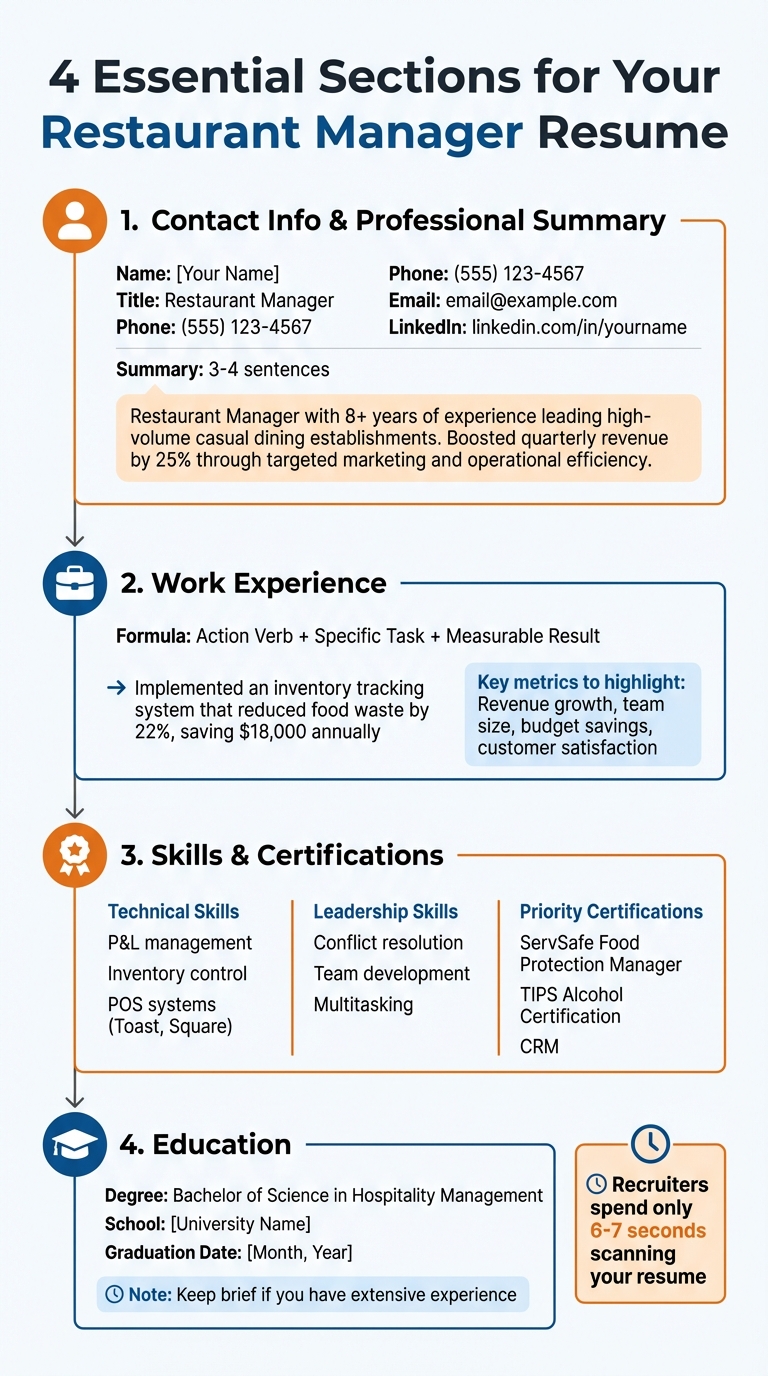
Restaurant Manager Resume Structure: 4 Essential Sections
When crafting your restaurant manager resume, focus on including only the most impactful details. A well-structured, one-page resume should have four key sections that showcase your expertise and achievements effectively.
Start with your Contact Information and Professional Summary at the top. Include your full name, professional title (like Restaurant Manager or Assistant Restaurant Manager), phone number, email, and LinkedIn profile. Follow this with a brief 3–4 sentence summary that highlights your value. For example: "Restaurant Manager with 8+ years of experience leading high-volume casual dining establishments. Boosted quarterly revenue by 25% at Spice & Spoon through menu optimization and reduced staff turnover by 30% with targeted training programs." This summary immediately communicates your strengths in the short time recruiters typically spend scanning resumes – around 7 seconds.
In the Work Experience section, focus on the results of your actions rather than just listing responsibilities. Use a formula like: Action Verb + Specific Task + Measurable Result. For instance, instead of saying "managed daily operations", try: "Implemented an inventory tracking system that reduced food waste by 22%, saving $18,000 annually." Highlight metrics like revenue growth, team size, budget savings, or customer satisfaction improvements. For example, Laura Bennett, a Restaurant Manager at Spice & Spoon in San Francisco, successfully negotiated vendor contracts that lowered operational costs by 15%.
The Skills and Certifications section should cover both technical skills and interpersonal strengths. Include operational skills like P&L management, inventory control, and proficiency with POS systems (such as Toast or Square). Pair these with leadership abilities like conflict resolution, team development, and multitasking. Add certifications such as the ServSafe Food Protection Manager as a priority, along with others like TIPS Alcohol Certification or Certified Restaurant Manager (CRM), if applicable. These credentials reinforce your qualifications before moving on to your education.
End with an Education section that lists your degree, school, and graduation date. If you’re a recent graduate, you might include relevant coursework like Hospitality Management. For those with extensive experience, keep this section brief and to the point.
How to Fit Everything on One Page
To make your resume fit on one page, focus on smart formatting that highlights your top achievements. This ensures that during the brief 6–7 seconds a recruiter spends scanning your resume, your most impressive qualifications grab their attention right away.
Formatting for Easy Reading
Start by tweaking your margins. Shrink them from the standard 1 inch to 0.5 inches to create more space. Choose a clean sans-serif font like Calibri or Arial, using 10–11 points for the body text and 12–14 points for headings. Keep line spacing between 1.0 and 1.15 for a polished look.
Use bold text for job titles and company names to establish a clear visual hierarchy. For your contact details, keep it concise: list your city, state, phone number, email, and LinkedIn URL on a single line. In the skills section, arrange your abilities horizontally with pipes separating them (e.g., P&L Management | Inventory Control | Toast POS). This layout saves space compared to a vertical bulleted list.
"Using action words can also help trim down the number of words used on your resume, making it easier to read and more impactful." – Kyle Thacker, Marketing Director, Backbar
For your work experience section, keep each bullet point to one or two lines. Begin with strong action verbs like "Streamlined", "Negotiated", or "Implemented." Write in concise phrases, avoiding unnecessary words – say "Daily duties" instead of "My day-to-day responsibilities included." Use digits for numbers (e.g., 10 instead of ten) to save space. Lastly, skip the "References available upon request" line; employers will ask for references during the interview stage anyway.
Once your formatting is clear and streamlined, use a hybrid resume format to balance your skills and experience effectively.
Using the Hybrid Resume Format
The hybrid resume format is ideal for showcasing both your skills and work history. This approach works especially well for roles like restaurant management, where specific skills and accomplishments are key. Start with a professional summary at the top, followed by a concise skills section that highlights 6–8 core competencies. Then, list your work experience in reverse-chronological order, starting with your most recent job. This format meets the preferences of Applicant Tracking Systems (ATS), which favor chronological layouts, while still emphasizing the specialized skills that make you stand out.
Focus on the last 10–15 years of your career or your three to four most relevant roles. If you’ve held multiple positions at the same company, combine them into one entry to save space. Keep your education section brief, listing only your degree, school, and graduation year. Finally, save your finished resume as a PDF to ensure the formatting stays intact across all devices and software.
Tailoring Your Resume for Different Restaurant Types
Once you’ve got your one-page resume formatted and ready, the next step is to adjust its content to fit the type of restaurant you’re applying to. Each restaurant category comes with its own set of priorities. For example, fine dining establishments focus on exceptional guest experiences and high service standards, while high-volume chains look for operational efficiency and logistical skills. To stand out, highlight the qualities that align with the specific restaurant type you’re targeting.
For fine dining roles, emphasize your ability to deliver outstanding service. Use keywords like Guest Relations, Service Standards, and Staff Mentorship in your professional summary and skills sections. For instance, Alexandra Papp, a manager at MIRA Restaurant in Los Angeles, successfully managed three locations, achieved a 93% staff retention rate, and reduced expenditures by 27% in just one year. Achievements like these, combining service excellence with business expertise, are exactly what fine dining recruiters look for.
"A fine-dining restaurant might care more about customer service and guest experience, while a high-volume chain will want to know you can handle fast-paced operations and logistics."
On the other hand, casual dining and fast-casual roles require you to highlight speed and efficiency. Showcase accomplishments like cutting customer wait times by 15% or streamlining counter operations during busy hours. Demonstrate your expertise with tools like POS systems, inventory software, and scheduling platforms. If the job description mentions terms like "workflow optimization" or "cost control measures", use those phrases in your resume. Always back up your claims with numbers, such as managing a team of 30 employees or increasing revenue by 22% through operational improvements.
Pay close attention to the keywords in each job posting and incorporate them naturally into your resume. Phrases like "luxury service", "high-volume operations", or "fast-paced environment" can make a big difference. These keywords are crucial for passing Applicant Tracking Systems, which can filter out up to 75% of resumes that don’t match the job’s language.
Conclusion
Your one-page restaurant manager resume can be your gateway to landing interviews in a competitive job market. The key lies in focusing on three core elements: achievements, proper formatting, and customization.
Start by turning job duties into measurable achievements. Use action verbs and quantifiable results to showcase how you’ve impacted areas like revenue growth, labor cost reduction, or guest satisfaction. This approach transforms your resume into a compelling narrative of your professional success.
For ATS (Applicant Tracking System) compatibility, keep things simple. Use standard headers like Professional Experience and Skills, stick to clean fonts such as Arial or Calibri, and integrate keywords directly from the job posting. When saving your file, opt for a DOCX or text-based PDF format to avoid issues with parsing systems.
"Most restaurant manager resumes fail because they read like job descriptions instead of achievement stories."
With food service management positions expected to grow by 9% (around 27,600 new jobs) by 2026, a polished, one-page resume is more critical than ever.
So, don’t wait. Highlight your achievements, format your resume for both ATS and hiring managers, and tailor it to each opportunity. Your next interview could be just one page away.
FAQs
How can I make sure my resume is ATS-friendly?
To make sure your resume works well with Applicant Tracking Systems (ATS), stick to a straightforward design without using tables, graphics, or overly decorative elements. Naturally weave in keywords from the job description, especially in your skills and experience sections. Use standard headers like Experience, Skills, and Education to keep things clear and easy to navigate.
Highlight measurable accomplishments to demonstrate your impact – for example, mention how you boosted revenue by a specific percentage or streamlined a process for better efficiency. When saving your resume, opt for a plain-text-friendly format like PDF (unless the job posting specifies otherwise) to avoid any issues with ATS compatibility.
What key achievements should I include on a restaurant manager resume?
When writing your restaurant manager resume, emphasize accomplishments that demonstrate your leadership and the positive changes you’ve driven. Focus on measurable outcomes like boosting revenue, reducing expenses, or improving customer satisfaction rates. Share examples of team-building efforts, staff training initiatives, or streamlining operations that resulted in better performance or efficiency.
Employers are drawn to concrete results, so include specifics – percentages, dollar figures, or other measurable data. For instance, you might say, "Introduced a new inventory system that cut food waste by 20%" or "Increased monthly revenue by $15,000 through targeted promotional strategies." These details highlight your ability to make a real impact.
How can I customize my resume for different types of restaurants?
To make your resume stand out for different restaurant types, focus on highlighting skills and experiences that align with the restaurant’s vibe, audience, and operations. For fine dining establishments, emphasize your attention to detail, expertise in upscale customer service, and familiarity with high-end service standards. On the other hand, if you’re targeting casual or quick-service restaurants, showcase your ability to handle high-volume operations, supervise staff, and maintain efficiency under pressure.
Digging into the restaurant’s values and management style can also help you fine-tune your resume. If the restaurant prioritizes teamwork and a close-knit environment, highlight your collaborative nature and ability to create a positive team dynamic. If they lean toward a fast-paced, results-driven approach, bring attention to your leadership skills, quick decision-making, and multitasking capabilities. Tailoring your resume this way shows you’re in tune with the restaurant’s needs and boosts your chances of getting that interview.