

Kitchen Manager Resume: Skills Hiring Managers Actually Care About
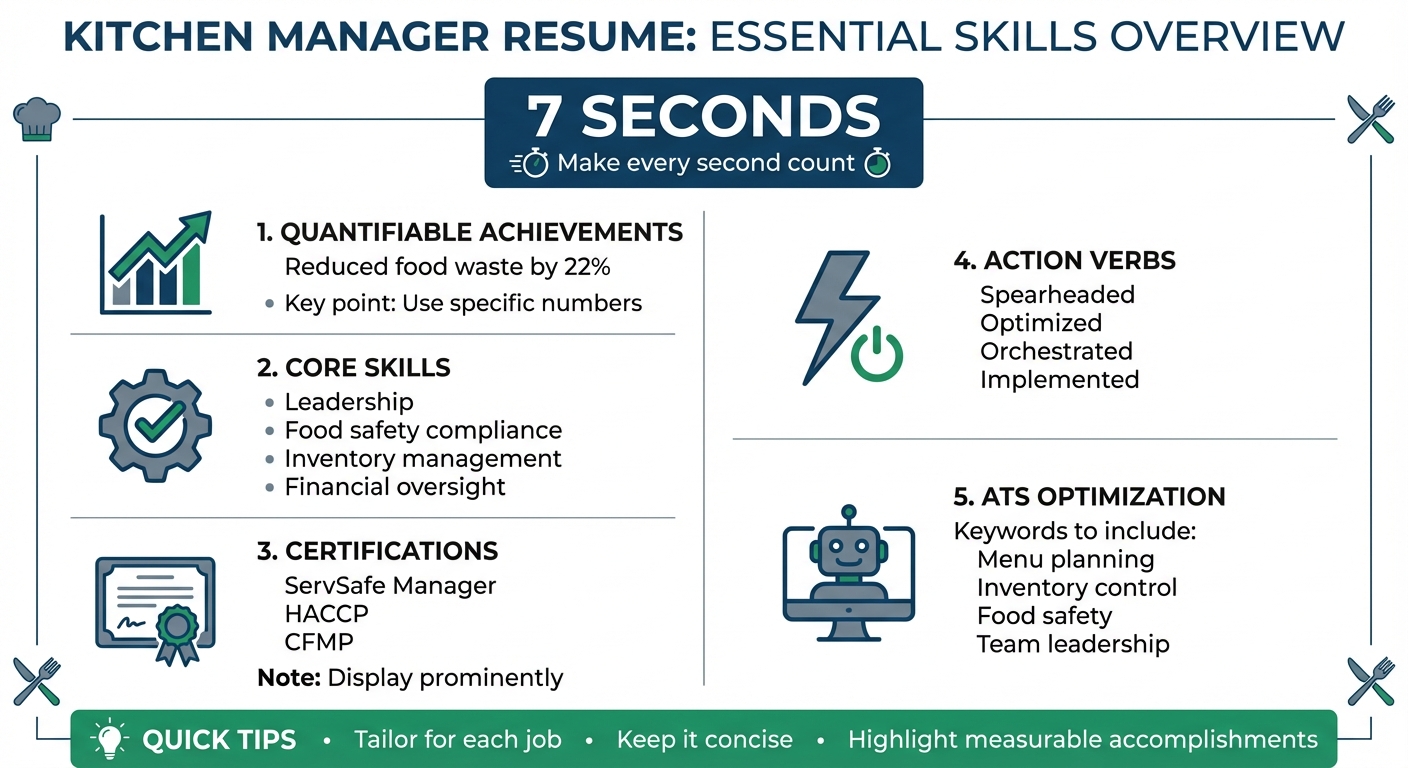
Recruiters spend just 7 seconds scanning resumes, so yours needs to stand out immediately. To land a kitchen manager role, focus on these key areas:
- Quantifiable Achievements: Use specific numbers like "reduced food waste by 22%" to highlight your impact.
- Core Skills: Emphasize leadership, food safety compliance, inventory management, and financial oversight.
- Certifications: Include relevant credentials like ServSafe Manager or HACCP prominently.
- Action Verbs: Use strong language like "Spearheaded" or "Optimized" to convey authority and results.
- ATS Optimization: Incorporate keywords such as "menu planning" and "inventory control" to pass applicant tracking systems.
Tailor your resume for each job, and keep it concise yet impactful. Highlight measurable accomplishments and certifications in your professional summary to grab attention instantly.
Top Kitchen Manager Resume Skills Hiring Managers Want
Writing a Strong Professional Summary
Key Elements of an Effective Summary
Your professional summary serves as a quick pitch that captures your expertise in kitchen management. Start by mentioning your years of experience to establish credibility right away. Then, showcase your key strengths, such as inventory management, team leadership, or labor cost control. If you hold certifications like ServSafe Manager, make sure to include them. Wrap it up with a statement about the specific value you bring – whether it’s reducing waste, streamlining operations, or driving measurable improvements.
For seasoned professionals, focus on results you’ve achieved. For those just starting out, emphasize transferable skills and passion for the role. Keep in mind, a summary is about showcasing what you’ve already accomplished, while an objective is more about future aspirations.
Using Action Words That Get Results
The words you choose can make or break your summary. Strong action verbs convey confidence and authority. Instead of saying, "responsible for managing staff", opt for dynamic verbs like Spearheaded, Optimized, or Orchestrated. Combine these with measurable outcomes to clearly illustrate your impact. For instance, instead of "improved kitchen operations", try:
- "Implemented inventory systems that reduced food waste by 25%."
- "Trained team members to achieve a 99% order accuracy rate during peak hours".
Adding specific numbers or percentages makes your achievements stand out. These strategies not only make your summary more compelling but also set the stage for highlighting your core skills in the rest of your resume.
Restaurant Manager Resume Summary II How To Write Professional Headline – Talks Legal Tips
Core Kitchen Management Skills to Include
Hiring managers are always on the lookout for skills that prove you can handle the fast-paced demands of a busy kitchen. Your resume should not just list these skills but also show how you’ve used them to deliver results. Three key areas stand out: leadership, inventory control, and food safety compliance. Let’s break down how these skills translate into measurable achievements.
Leadership and Team Coordination
Strong leadership can make or break a kitchen’s performance. Employers want to see that you can train staff, resolve conflicts, and delegate tasks strategically. The key is to provide quantifiable examples. For instance, at The Urban Fork in Springfield, Kitchen Coordinator Sophia Singh led a team of 15 employees from October 2023 to October 2025. By improving workflow coordination, she increased team efficiency by 20%.
When describing your leadership experience, use action words like Mentored, Facilitated, or Orchestrated. Show how you’ve handled high-pressure situations, like managing peak dining hours or special events. Isabella Cruz, Culinary Operations Manager at Gourmet Innovations Inc in Buffalo from 2021 to 2023, developed staff training programs that reduced turnover by 30%. Strategic delegation is another critical skill. As noted by Prospects.ac.uk:
"Delegation isn’t a sign of weakness. In fact, it can increase a manager’s ability to accomplish more work while developing the team’s confidence and skills".
Leadership isn’t just about managing people – it’s also about ensuring smooth operations, which ties directly into inventory management.
Inventory and Supply Chain Management
Managing inventory effectively is crucial for controlling costs and reducing waste. Hiring managers want to see that you understand FIFO protocols, par level maintenance, and vendor negotiations. For example, from January 2018 to 2025, Owen Wright, Head Chef at The Gourmet Bistro in Chicago, implemented an inventory system that cut food waste by 25% and saved $20,000 annually by optimizing vendor contracts.
Highlight any tools you’ve used, such as POS systems or Restaurant Management Systems, and provide examples of cost-saving initiatives. One standout example: a Kitchen Manager at Rolling Meadows Middle School in Illinois reduced food costs by 15% in August 2018 by improving vendor relationships and aligning purchases with actual usage needs.
These examples show that efficient inventory management doesn’t just save money – it also ensures a sustainable kitchen operation.
Food Safety and Sanitation Compliance
Food safety is a non-negotiable in any kitchen. Certifications like ServSafe Manager or HACCP can set you apart, but don’t stop there. Highlight specific achievements, such as maintaining a 100% inspection score or achieving zero violations. For instance, Emily Rivera, a Sous Chef at Tartine Bakery & Manufactory in San Francisco, ensured strict compliance with health regulations from March 2016 to May 2019, resulting in zero violations during her tenure.
Additionally, food waste reduction initiatives often go hand-in-hand with food safety. From April 2017 to May 2021, Dorothy R. Bowles, Kitchen Manager at Riviera Restaurant in Virginia Beach, introduced portion control measures that cut kitchen waste by 22%. Training staff on sanitation protocols is another way to demonstrate your commitment to maintaining high standards across the board.
sbb-itb-306cd44
Showing Operations and Financial Skills
Demonstrating your operational and financial expertise is a powerful way to highlight your value as a kitchen manager. These skills go beyond the basics, showing how you can directly influence a restaurant’s profitability and smooth day-to-day operations. Employers want clear, measurable examples that prove your ability to manage schedules, control costs, and negotiate with vendors effectively.
Scheduling and Shift Management
Creating effective schedules isn’t just about filling shifts – it’s about balancing productivity and labor costs. For instance, at Coached.com, a Chef de Partie strategically adjusted schedules to cut labor costs by 10%, all while maintaining efficiency. When discussing your experience, be specific. Did you manage a team of 20 during regular hours? Or were you coordinating over 50 staff members across multiple locations or 24/7 operations?
Mention tools like Kronos, 7shifts, or PeachWorks that helped you maintain seamless operations, especially during peak periods. Use dynamic phrases like Streamlined, Orchestrated, or Optimized to describe how you handled unexpected call-outs or seasonal rushes. These details show you’re not just filling gaps but actively improving operations.
Once scheduling is under control, financial management becomes the next critical area to showcase.
Food Cost Control and Budgeting
Budget management is where operational skills meet business strategy. For example, at Feastly in Virginia Beach, Kitchen Manager Dorothy R. Bowles reduced food and labor costs by 15% while keeping customer satisfaction high. Employers want to see specific numbers that reflect your financial impact – percentages, dollar amounts, or other concrete metrics.
Highlight your experience with P&L management, inventory optimization, and menu planning that drove revenue growth – like increasing profits by 25%. As Mike Potter, CPRW, explains, hiring managers look for candidates who can demonstrate skills like "inventory management proficiency or staff training techniques". Mention tools such as Microsoft Excel, NetSuite, or ChefTec to show your familiarity with financial tracking. If you’ve conducted variance analysis to identify and fix inefficiencies, explain how it helped reduce costs or improve margins.
Vendor Negotiation and Procurement
Your ability to negotiate with vendors can significantly cut costs through tiered pricing or volume discounts. Share specific examples, like securing volume-based deals or implementing local sourcing strategies that reduced food costs. These actions show you’re proactive about maintaining profitability.
Highlight tools like MarketMan, BlueCart, or Kitchen Cut to emphasize a data-driven approach to supplier negotiations. Show how you established protocols like FIFO rotation or conducted weekly spot checks to ensure quality and minimize waste. If you’ve adopted sustainable practices, such as eco-friendly packaging or local sourcing, include those details – they reflect a forward-thinking approach to operations. Regularly reviewing supplier performance also demonstrates your commitment to maintaining cost efficiency and quality.
Certifications and Skills for RR Guy Applications
If you’re aiming to enhance your resume for kitchen manager roles on RR Guy, certifications can give you a strong edge. These credentials not only validate your expertise but also help align your skills with the specific demands of the job. Employers often look for certifications that highlight your knowledge in food safety, operations, and management – key areas that can make your application stand out.
Important Certifications to Include
The ServSafe Manager Certification is a must-have in the food industry. Covering food safety regulations, hygiene, and safe food handling, this certification costs between $100–$200. The National Center for Environmental Health at the CDC notes:
"Certified kitchen managers are restaurant employees with management responsibility who have passed a test to show knowledge of food safety".
This certification is particularly valuable because it demonstrates your understanding of the financial impact of food safety. For instance, a single foodborne illness outbreak can cost a restaurant anywhere from $4,000 to $2.2 million.
If you’re managing more complex food production environments, consider the Hazard Analysis and Critical Control Points (HACCP) certification. Although it comes with a higher price tag of $2,000–$5,000, it’s internationally recognized and shows you’re adept at implementing systematic food safety protocols. Other valuable certifications include the Certified Foodservice Management Professional (CFMP), which highlights skills in HR, finance, and customer service.
For those aiming for senior roles, the Certified Executive Chef (CEC) from the American Culinary Federation represents a top-tier credential. It costs between $1,000–$2,500 and signifies mastery in culinary management. Additionally, the National Sanitation Foundation (NSF) Food Safety Manager certification, priced at $100–$200, ensures you meet local and state regulations aligned with the FDA Food Code. Most certifications remain valid for five years before requiring renewal.
Matching Your Skills to RR Guy Job Listings
Once you’ve secured the right certifications, focus on tailoring your resume to match the skills highlighted in RR Guy job postings. The platform allows candidates to explore a variety of restaurant management roles across casual dining, fast casual, fine dining, and more. To improve your chances, study each job description carefully and identify keywords like "menu planning", "inventory management", or "food safety compliance". These keywords are crucial for applicant tracking systems (ATS).
When listing certifications like ServSafe or HACCP, place them prominently in your professional summary rather than burying them in an education section. Use RR Guy’s advanced search tools to filter positions by location and category, then customize your resume to fit the specific needs of each role. For instance, fine dining jobs may require you to emphasize expertise in high-end ingredients and plating, while fast-casual positions might prioritize speed and efficiency.
Be sure to include certification expiration dates to show they’re up-to-date. Use metrics to quantify your achievements, such as "Reduced food waste by 22% through portion control" or "Managed a team of 20 across multiple shifts". Combining these credentials with tailored keywords can significantly boost your resume’s effectiveness and help you stand out to potential employers.
Conclusion: Building a Strong Kitchen Manager Resume
Top Skills Hiring Managers Want to See
To stand out as a kitchen manager, focus on the skills that restaurant employers value most. Leadership and team management are crucial – employers want to see your ability to train, motivate, and coordinate a diverse kitchen team. Operational expertise is also key, covering areas like inventory management, food safety compliance, and quality assurance. Financial management skills, such as controlling food costs, budgeting, and negotiating with vendors, highlight your ability to maintain profitability. On top of that, technical know-how with POS systems and scheduling software, combined with problem-solving and communication skills, shows you’re ready to handle the fast-paced demands of the role.
A review of over 5,000 management resumes from 2023-2024 revealed leadership and customer service as the most frequently highlighted skills on successful resumes. These skills are the backbone of a resume that not only grabs attention but also delivers results in restaurant management. Use this foundation to refine your resume further with targeted strategies.
Final Resume Tips
The difference between a good resume and a great one often comes down to clarity and measurable impact. Highlight your achievements with specific examples, like "reduced food waste by 22% through portion control", to show exactly how you’ve made a difference.
To improve your chances of passing Applicant Tracking Systems (ATS), incorporate keywords from the job description. Terms like "inventory control", "ServSafe", and "menu planning" help signal your qualifications to automated systems.
Keep your resume concise – stick to one page for junior roles and two for senior positions. Use a reverse-chronological format, straightforward fonts, and clear headings to make your qualifications easy to scan. Proofread meticulously to catch typos or errors, and consider asking a colleague to review it for a fresh perspective. Save your resume as a PDF to ensure consistent formatting across devices.
Tailor your resume to each job application by aligning your skills with the specific kitchen environment, whether it’s fine dining, fast-casual, or catering. Highlight relevant certifications and examples that match the job description. Don’t forget to update your LinkedIn profile to mirror your resume, as recruiters often check social media during the hiring process. With RR Guy’s free platform, you can explore restaurant management roles across various categories and customize your application for each opportunity.
FAQs
What certifications are important to include on a kitchen manager resume?
Including certifications on your kitchen manager resume is a smart way to showcase your expertise. Highlight well-known industry certifications like the ServSafe Manager Certification or similar food safety and sanitation training. These credentials demonstrate your ability to uphold strict safety standards and adhere to health regulations – both of which are essential in a kitchen management role.
You should also consider listing certifications in kitchen management or leadership. Programs from culinary schools or professional organizations can emphasize your abilities in team coordination and running kitchen operations smoothly. By adding these certifications, you validate your qualifications and make your resume more appealing to hiring managers.
How can I use numbers to showcase my achievements on a kitchen manager resume?
To make your kitchen manager resume grab attention, focus on specific, measurable achievements that demonstrate your impact. For instance, you could highlight accomplishments like increasing customer satisfaction by 15%, cutting food waste by 20%, or saving $10,000 annually through smarter inventory management.
Additionally, underscore operational successes, such as improving kitchen efficiency, ensuring safety compliance, or increasing staff retention. Including solid numbers not only proves your results-oriented mindset but also helps hiring managers clearly see the value you bring to the table.
What key skills should a kitchen manager include on their resume to impress hiring managers?
Hiring managers prioritize qualities like leadership, expertise in food safety, inventory management, team training, and effective communication when looking for kitchen managers. These skills are critical for ensuring smooth kitchen operations, upholding health and safety standards, and creating a positive and efficient workplace.
To make an impression, focus on specific accomplishments that highlight these strengths. For example, you could mention implementing an inventory system that reduced food waste or leading a team that consistently surpassed customer satisfaction targets. Customize your resume to clearly demonstrate how your background aligns with these key areas.