
Resume Templates for Restaurant Management Jobs
Restaurant management resumes need to focus on measurable achievements and industry-specific skills like food safety, cost control, staff management, and customer service. Tailored templates can help highlight your strengths based on the type of restaurant you’re targeting. Whether you’re applying to fine dining, fast casual, or quick service roles, your resume should emphasize results such as increasing customer retention, reducing food waste, or boosting profitability. Using tools like RR Guy, a job board designed for restaurant careers, can streamline your job search with targeted listings and alerts.
Key Takeaways:
- Focus on measurable achievements like "cut food waste by 10%" or "boosted customer retention by 20%."
- Include sections for contact info, professional summary, work experience, education, certifications, and core skills.
- Use U.S. formatting standards: clean fonts, reverse chronological order, and PDF submission.
- Tailor your resume to the restaurant type (e.g., fine dining vs. quick service) and use relevant keywords.
- RR Guy offers 145 current job openings and tools to match your expertise with the right roles.
Key Sections of a Restaurant Management Resume
Required Resume Components
To stand out in the competitive restaurant management field, your resume needs specific sections that hiring managers expect. Each part serves a distinct purpose in showcasing your qualifications.
Start with Contact Information, which forms the base of your resume. Include your full name, phone number in the format (XXX) XXX-XXXX, professional email address, and your city and state. Skip the full street address to maintain privacy.
Next, craft a compelling Professional Summary in 2-4 lines. This section should spotlight your experience, leadership style, and major accomplishments. For example: "Results-driven restaurant manager with over 7 years of experience leading high-performing teams, boosting guest satisfaction by 20%, and cutting costs through process improvements." This gives hiring managers a quick snapshot of your value.
The Work Experience section is the heart of your resume. List your roles in reverse chronological order, focusing on measurable achievements rather than just job responsibilities. Use action verbs and quantify your results. For example, instead of saying "managed staff", write "Led a team of 15, increasing staff retention by 20%." Or, "Redesigned menu, increasing average ticket size by 15%," and "Maintained a 100% health inspection pass rate for two consecutive years."
In the Education section, list your highest degree first, including the degree name, institution, location, and graduation year. If you’re an experienced manager, keep this section brief. For recent graduates, highlight relevant coursework if you lack extensive work history.
Certifications are critical for restaurant management roles. Create a dedicated section for credentials like ServSafe Food Protection Manager, Alcohol Service Certification, and CPR/First Aid. Include the full certification name, issuing organization, and expiration date (if applicable). These certifications demonstrate your commitment to safety and compliance standards.
Finally, include a Core Skills section to emphasize abilities directly tied to restaurant operations. Highlight skills like team leadership, inventory management, budgeting, customer service, food safety compliance, and conflict resolution. Link these skills to achievements when possible, such as "Implemented inventory systems, reducing food waste by 25% and saving $5,000 monthly."
By organizing your resume with these key sections, you’ll present a professional and results-oriented profile that aligns with industry expectations.
U.S. Resume Formatting Guidelines
In the United States, restaurant management resumes follow specific formatting standards to ensure clarity and professionalism. These details make a big difference in how your resume is perceived.
Length depends on your experience. If you have less than five years of experience, keep your resume to one page. For seasoned professionals with extensive backgrounds, two pages are acceptable – but no more. Hiring managers often skim resumes, so concise and well-structured content is crucial.
File format is another important detail. Submitting your resume as a PDF ensures your formatting stays intact across devices and operating systems. Unless an employer specifically requests a DOCX file, stick with PDF as the default.
Stick to standard page formatting: use an 8.5" x 11" page size with 1" margins. Choose clean, professional fonts like Arial, Calibri, or Times New Roman in sizes between 10 and 12 points. These fonts ensure readability both on screen and in print.
For dates, follow U.S. conventions by using the month/year format (e.g., 06/2023–10/2025). Maintain U.S. spelling throughout, such as "organization" instead of "organisation" and "analyze" rather than "analyse."
Numbers should also follow American formatting rules. Use commas for thousands and periods for decimals. For example, write $10,000.00 for currency and percentages like 15% or 20%. These small details reflect your attention to precision.
A resume that’s well-organized, clearly formatted, and packed with measurable accomplishments can boost your chances of getting an interview by up to 40% in the hospitality industry. This is why following these guidelines and emphasizing your results can make a significant difference.
| Resume Section | Essential Elements | U.S. Formatting Notes |
|---|---|---|
| Contact Information | Full name, phone (XXX) XXX-XXXX, email, city/state | No full address needed for privacy |
| Professional Summary | 2-4 lines highlighting experience and achievements | Focus on measurable results |
| Work Experience | Action verbs, quantified results, reverse chronological | Use month/year date format |
| Education | Degree, institution, city/state, graduation year | Keep brief for experienced candidates |
| Certifications | ServSafe, alcohol service, CPR with expiration dates | Dedicated section for visibility |
| Core Skills | Leadership, financial management, compliance | Pair with specific achievements |
Top Resume Templates for Restaurant Management Jobs
Best Resume Templates
Choosing the right resume template can make a big difference in landing a restaurant management role. These positions demand a balance of operational expertise and leadership skills, and the right design can help highlight those qualities effectively. Below are some template styles tailored for various roles within restaurant management.
Modern Professional templates are ideal for fine dining and upscale restaurants. These templates feature clean designs with bold headers and ample white space, giving them a polished, high-end look. They emphasize leadership achievements and strategic thinking, making them a great fit for candidates aiming for executive roles or positions in premium establishments. For instance, you might showcase an accomplishment like, "Implemented a wine pairing program that boosted average check size by 22%."
Executive Restaurant Manager templates cater to senior-level professionals managing multiple locations or overseeing large-scale operations. These templates focus on strategic accomplishments and metrics that demonstrate financial and operational impact. They’re perfect for area directors, regional managers, or those with corporate restaurant experience. A strong example might include, "Managed $8.5M in annual revenue across 12 locations."
Hospitality-Focused templates work best for roles that prioritize guest satisfaction. These templates highlight customer service achievements, team development, and metrics related to guest experience. They’re an excellent choice for boutique restaurants, family dining spots, or venues where personal service is a top priority. For example, you could feature a success like, "Increased repeat customer rate by 28% through personalized service training."
Operations-Driven templates are designed for fast casual and high-volume restaurants, where efficiency and cost control are key. These templates emphasize operational metrics, process improvements, and team productivity. They’re well-suited for candidates in chain restaurants or establishments focused on speed and consistency. A standout achievement might read, "Reduced average order time by 45 seconds through kitchen workflow optimization."
Entry-Level templates are perfect for new managers or those transitioning into restaurant management from other industries. These templates focus on transferable skills, relevant training, and potential for growth. They highlight education, certifications, and leadership experience, even if gained outside the restaurant industry. For instance, you might include, "Completed ServSafe Manager Certification with a 98% score."
Each of these templates is tailored to specific career stages and restaurant types. The key is to match your experience and goals with the template that best highlights your strengths.
Template Comparison Chart
To help you decide which template fits your needs, here’s a quick comparison of their features and ideal applications:
| Template Type | Best For | Key Features | Ideal Candidate Profile |
|---|---|---|---|
| Modern Professional | Fine dining, upscale restaurants | Sleek design, leadership focus, quantifiable results | Experienced managers, executive roles |
| Executive Restaurant Manager | Multi-unit, corporate roles | Strategic planning, multi-site oversight | Senior managers, area directors |
| Hospitality-Focused | Boutique, guest-centric venues | Customer service, guest experience, soft skills | Managers in high-touch environments |
| Operations-Driven | Fast casual, high-volume establishments | Efficiency, cost control, team management | Managers in busy, operational settings |
| Entry-Level | First-time managers, quick service | Transferable skills, training, growth potential | New managers, recent graduates |
When selecting a template, think about your strongest achievements and the type of restaurant you’re targeting. For instance, if you excel at cost-saving measures and streamlining operations, an Operations-Driven template will work well. On the other hand, if your strengths lie in creating memorable guest experiences, a Hospitality-Focused template is the better choice.
You can also adapt your resume for different opportunities. A mid-career manager might use an Operations-Driven template for chain restaurant roles but switch to a Modern Professional template when applying to fine dining establishments. This flexibility allows you to present your experience in a way that aligns with the specific job requirements.
Tailoring Resumes for Different Restaurant Types
Restaurant Type Customization
Each type of restaurant values specific skills, so it’s essential to adjust your resume to highlight the accomplishments that matter most to the role.
Fine Dining Establishments
Fine dining restaurants prioritize exceptional guest experiences, staff training, and maintaining high standards. To stand out, showcase achievements like earning a local culinary award or completing key certifications that demonstrate your expertise.
Fast Casual Restaurants
In fast casual settings, efficiency, cost control, and menu innovation are critical. Highlight measurable results, such as cutting waste by 25% and saving $5,000 a month, to demonstrate your ability to drive operational improvements.
Casual Dining Operations
Casual dining managers need strong leadership, excellent customer service, and operational efficiency. Emphasize accomplishments like improving team performance by 30% through targeted training programs to show your ability to manage larger teams effectively.
Quick Service Restaurants
Quick service roles demand managers who thrive in high-volume environments and solve problems quickly. Highlight achievements such as reducing meal prep times by 15% during peak hours to demonstrate your focus on speed, consistency, and process improvements.
Incorporate relevant keywords like guest relations, cost reduction, and process improvement to align your resume with the priorities of each restaurant type. These details make your application more targeted and impactful.
Using RR Guy‘s Job Categories
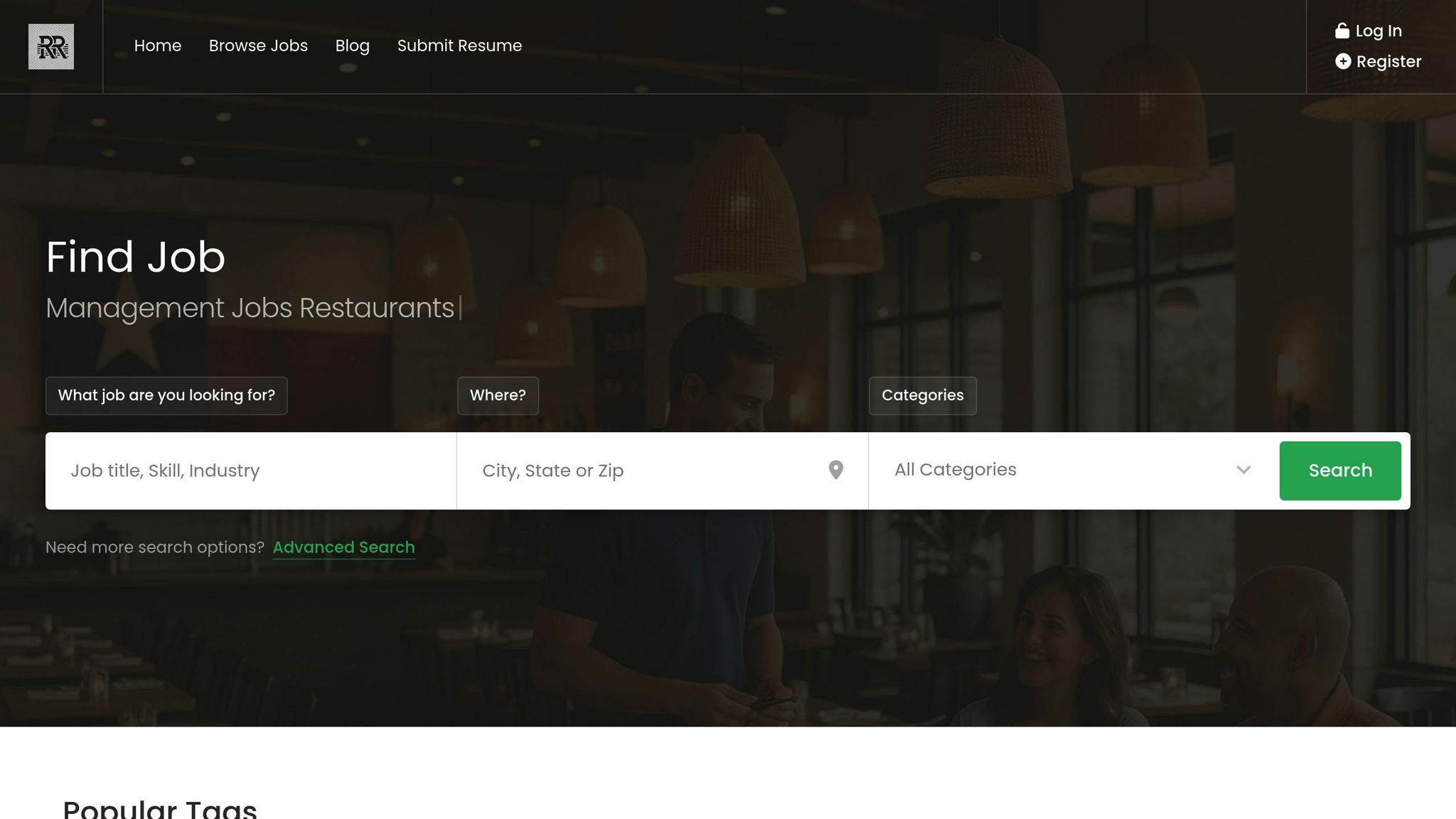
RR Guy’s job categories provide a helpful framework for tailoring your resume to specific restaurant roles. By exploring these categories, you can refine your application to meet the distinct demands of each segment. For example:
- In the casual dining category, job listings often emphasize team leadership and customer service. Use these insights to fine-tune your resume summary and highlight related achievements.
- The fast casual category frequently focuses on innovation, efficiency, and growth potential. Success stories on RR Guy show that candidates who highlight process improvements and adaptability often secure roles in this segment. Adjust your resume to feature operational excellence and experience with technology integration.
RR Guy’s advanced search tools allow you to filter jobs by requirements, location, and experience level, helping you spot patterns in employer expectations. For instance, if fine dining roles consistently mention wine knowledge, make sure sommelier certifications or training are prominently displayed. Similarly, for quick service roles that stress multi-unit oversight, lead with your regional or area management accomplishments.
Take advantage of RR Guy’s alert feature to stay updated on trending certifications and industry standards. Regularly updating your resume with these insights, while incorporating keywords relevant to the role, can significantly boost your chances of getting noticed. For instance, fine dining candidates might emphasize guest experience and sommelier training, while fast casual applicants could focus on menu development and digital ordering systems.
sbb-itb-306cd44
Resume Optimization and Submission Tips
Resume Improvement Best Practices
To make your resume stand out, use a clean, professional format that aligns with U.S. standards. Pay attention to details like date formats, currency symbols, and number presentation to ensure your resume looks polished.
One of the best ways to grab attention is by quantifying your achievements. For example, instead of saying "reduced food waste", write "reduced food waste by 25%, saving $5,000 monthly." Or, highlight customer engagement with something like, "increased repeat customer visits by 18%." Data shows that resumes featuring measurable accomplishments are 30% more likely to secure interviews in the hospitality industry [Enhancv, 2025].
Another crucial step is to include relevant keywords. Use terms like "food safety compliance", "inventory management", "team leadership", and "budget management" to ensure your resume passes applicant tracking systems (ATS). Action verbs are your friend here – words like "led", "implemented", and "streamlined" convey leadership and initiative. For instance, say "Led a team of 25 staff members to achieve an 18% increase in repeat customer visits" instead of opting for passive phrases.
Keep your formatting simple for ATS compatibility. Stick to standard section headings and save your resume as a .docx or PDF file. This ensures your content is easily readable by both recruiters and automated systems.
Once your resume is optimized, you’re ready to submit it through RR Guy’s platform.
Submitting Resumes on RR Guy
After fine-tuning your resume, submitting it on RR Guy’s platform is quick and straightforward. This tool simplifies the application process for restaurant management professionals. Start by creating a free account or logging into your existing one at rrguy.com/dashboard/.
In October 2025, RR Guy emphasized its easy-to-use dashboard with a clear prompt: "Upload your resume to get started." This dashboard acts as your central hub, where you can track your application progress, set follow-up reminders, and get updates about new job opportunities that match your profile.
One standout feature is the ability to set up job alerts. You can customize these alerts based on criteria like restaurant type, location, salary range, and your experience level. These notifications ensure you’re among the first to hear about openings that fit your preferences. The platform also allows you to browse job categories – whether it’s casual dining, fine dining, fast casual, or quick service. This feature not only helps you find opportunities but also gives insight into what employers in different segments are looking for, so you can refine your application strategy.
Resume Updates and Customization
Submitting your resume is just the beginning. To stay competitive, make it a habit to update your resume every three months. Keep a master version on hand and create tailored versions for specific roles.
Customizing your resume for each job application can significantly improve your chances of getting noticed. Research indicates that tailored resumes have a 50% higher callback rate compared to generic ones [Indeed, 2025]. When customizing, focus on the job description and highlight achievements that match the role’s priorities. For example, if the job emphasizes managing high-volume operations or team development, make sure those accomplishments are front and center.
To stay organized, label your tailored resumes clearly, such as "Resume_Fine_Dining_2025" or "Resume_Fast_Casual_2025." This way, you can quickly find the right version when applying.
Finally, use RR Guy’s dashboard to track your applications and see which resume versions perform best. By monitoring response rates and tweaking your approach based on real data, you can continuously refine your materials and improve your chances of landing interviews.
How To Write A Restaurant Manager Resume? – Job Success Network
Conclusion
An effective restaurant management resume highlights the skills and accomplishments that matter most to employers in the industry. Using tailored resume templates allows you to showcase measurable achievements that clearly demonstrate your value to potential employers.
But a strong template is just the starting point – customization is key. Different restaurant types prioritize different skills, so adjust your resume to fit the role. For example, fine dining establishments may focus on menu development and guest experience, while fast-casual chains might value expertise in high-volume operations. Aligning your experience with the employer’s needs can make a significant difference in catching their attention.
Tools like RR Guy simplify the job search process with features such as targeted job listings, 145 current openings, and customized job alerts. These resources make it easier to apply industry insights directly to your resume strategy. Once you’ve crafted a strong resume, remember to keep it updated and relevant.
Regularly refreshing your resume and tailoring it to each opportunity helps you stay competitive in the ever-changing restaurant management field. By following U.S. resume formatting standards, incorporating industry-specific keywords, and taking advantage of RR Guy’s tools, you’ll be well-prepared to stand out.
In the world of restaurant management, measurable achievements and strong leadership skills are what set candidates apart. With the right approach, your resume can become the key to advancing your career.
FAQs
How can I customize my restaurant management resume for different types of restaurants?
To craft a standout restaurant management resume, make sure it aligns with the specific type of restaurant you’re targeting. Emphasize skills and experiences that match the establishment’s style – whether that’s leading a fine dining team or handling fast-paced, high-volume operations in a casual dining environment.
Showcase key accomplishments that demonstrate your value, such as boosting customer satisfaction, increasing revenue, or streamlining workflows. Tailor your tone and word choice to reflect the restaurant’s vibe – keep it polished and formal for fine dining or more relaxed and personable for casual or fast-casual spots.
If you’re exploring job opportunities, platforms like RR Guy can provide valuable insights into what employers in different restaurant niches are seeking.
What key sections should I include in a restaurant management resume to make it stand out?
To craft an impressive restaurant management resume, it’s essential to organize it in a way that highlights your qualifications and experience effectively. Start with your contact information right at the top – include your name, phone number, email address, and location. This ensures hiring managers can easily reach you.
Next, add a summary or objective. This section should briefly spotlight your skills, achievements, and career aspirations. Think of it as your elevator pitch – it should grab attention and make your goals clear.
In the experience section, focus on your previous roles in restaurant management. Highlight achievements such as boosting operational efficiency, increasing revenue, or leading successful teams. Use strong action verbs and quantify your results when possible – for example, "Implemented a new inventory system that reduced waste by 20%."
Include a skills section to underline relevant abilities like team leadership, customer service expertise, or financial oversight. Wrap up with your education, listing degrees, certifications, or any training programs that are directly tied to restaurant management.
For job opportunities in restaurant management, platforms like RR Guy can be a valuable resource. They specialize in connecting candidates with tailored roles and offer tools to help you submit your resume and land the right position.
How can RR Guy help me find a restaurant management job?
RR Guy offers a fantastic platform for anyone looking to grow their career in restaurant management. You can upload your resume so it’s visible to potential employers, explore job listings tailored to various categories like casual dining, fast casual, and fine dining, and even set up job alerts to stay updated on new openings.
Designed with the restaurant industry in mind, RR Guy makes your job search easier and helps connect you with employers seeking talented professionals like you.