

What to Put in a Professional Summary If You’re a Restaurant Leader
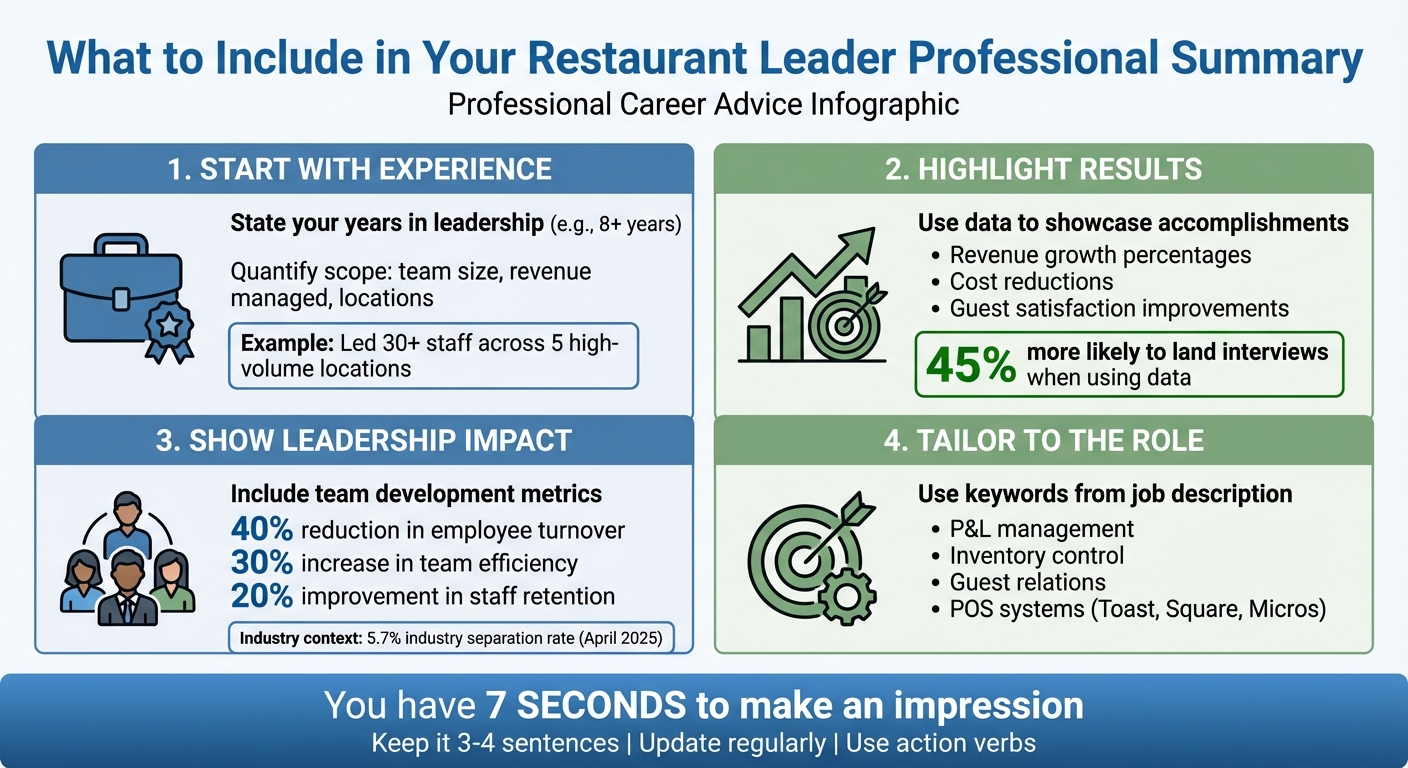
A professional summary is your resume’s first impression. For restaurant leaders, it’s a chance to immediately highlight your leadership, measurable achievements, and industry expertise. This section should focus on your experience, operational results, financial impact, and team development skills.
Here’s how to make it stand out:
- Start with Experience: Mention your total years in leadership roles and quantify your scope (e.g., team size, revenue managed).
- Highlight Results: Use data to showcase accomplishments – like revenue growth, cost reductions, or improved guest satisfaction.
- Show Leadership Impact: Include metrics on team retention, training outcomes, or operational improvements.
- Tailor to the Role: Use keywords from the job description (e.g., "P&L management", "inventory control") to align with ATS systems and employer needs.
Focus on concise, results-driven statements to grab attention in seconds. Tailor each summary to the specific role, showcasing how your skills and achievements align with the employer’s goals.
Professional Summary Framework for Restaurant Leaders
Restaurant Manager Resume Summary II How To Write Professional Headline – Talks Legal Tips
sbb-itb-306cd44
How to Open with Your Experience and Leadership Background
Start your resume summary by showcasing your experience and leadership roles in a way that grabs attention immediately. Recruiters typically spend only a few seconds scanning resumes, so it’s crucial to highlight your qualifications upfront. Clearly state your total years in the industry and the key leadership roles you’ve held to establish credibility right away.
As Gabriela Hernandez, CPRW and Career Advice Writer, explains:
Your resume summary is the first impression potential employers will have of you, making it important to present yourself effectively.
Tailor your introduction to match the type of restaurant you’re targeting – whether that’s fine dining, casual dining, or multi-unit operations. Begin by quantifying your experience and aligning it with the specific role.
State Your Years of Experience
The first step is to quantify your total years of experience in restaurant management. Many senior-level positions seek candidates with at least 5 years of leadership experience. Use a format like "8+ years" or "10+ years" to make your qualifications clear. For example:
- "Results-driven restaurant manager with 8+ years of experience."
- "Accomplished General Manager with over 10 years optimizing high-volume operations."
Pair these details with specifics about your leadership scope, such as the size of the team you managed or the number of locations you oversaw. For instance:
- "Led a team of 30+ staff members."
- "Directed operations across 5 high-volume locations."
Providing this level of detail helps paint a clearer picture of your capabilities.
Name the Leadership Positions You’ve Held
Next, highlight the most relevant leadership titles you’ve held, tailoring them to the type of restaurant or establishment. For fine dining, roles like Executive Chef, General Manager, or Food & Beverage Director stand out. In casual dining or chain restaurants, titles such as General Manager, Regional Manager, or Assistant Manager are effective. For quick-service environments, emphasize roles like Store Manager, Area Manager, or Shift Supervisor. If you’re applying to hotel restaurants, positions such as F&B Director, Banquet Manager, or Restaurant Manager are ideal .
Chef Edward Leonard, Certified Master Chef, emphasizes the importance of leadership clarity:
The key is to surround yourself with the best people, better than you at some of the skills that you probably don’t have …. Your job is to support them, manage them, make them part of the team, and lead them into the vision and direction you’re going.
If the job posting mentions terms like "high-volume operations" or "guest experience standards", incorporate these phrases naturally into your summary. This approach not only helps your resume pass Applicant Tracking Systems but also shows that you’re familiar with the specific demands of the role. Starting strong with these details sets the tone for showcasing your operational achievements and leadership strengths in later sections.
How to Present Your Operational and Financial Results
Once you’ve established your leadership background, shift gears to highlight the measurable impact you’ve had on restaurant performance. Numbers speak louder than words, and showcasing quantifiable results can make a significant difference. In fact, restaurant leaders who use data to back up their achievements are 45% more likely to land interview invitations.
Here’s a simple structure to follow when presenting your accomplishments: [Action Verb] + [Metric] + [Percentage/Dollar Amount] through [Specific Initiative]. For example, rather than saying "responsible for improving operations", you could write something like, "Streamlined inventory management to significantly reduce waste and lower costs." This approach not only clarifies what you did but also emphasizes the measurable results of your efforts.
Use Numbers to Show Operational Results
Operational efficiency metrics such as prime cost, table turn time, SPLH (Sales Per Labor Hour), or RevPASH (Revenue Per Available Seat Hour) can help illustrate your impact. For instance, prime cost for high-performing restaurants typically falls between 55–60%, compared to the industry average of 58–62%. Highlighting improvements in these areas can set you apart.
Real-world examples can make your achievements more relatable. Take K&N Management in Austin, for instance. By adopting operational standards from the Pal’s Business Excellence Institute, their Rudy’s Country Store and Bar-B-Q and Mighty Fine Burgers locations saw sales volumes grow to two-and-a-half times their original levels over a 10-year period ending in 2026. Another example comes from UAE-based pizza chain Pinza! In September 2024, under Managing Partner Tamer Elkhayat, the chain implemented Supy‘s Back of House software. This move led to an 85% reduction in variance and improved profit margins.
Adding timeframes like "within 12 months", "Year-over-Year (YoY)", or "Quarter-over-Quarter (QoQ)" can make your achievements more compelling. For example, if you improved RevPASH by 15% in six months, calculate and present it as a percentage increase using the formula: (New – Old) / Old × 100%. These kinds of results not only demonstrate your operational expertise but also show your ability to drive measurable success.
Describe Your Financial Impact
Operational improvements are just one side of the story. To paint a full picture, explain how your strategies directly influenced financial outcomes. Focus on both top-line growth (revenue) and bottom-line improvements (profit). For example, you could mention managing a $2 million annual F&B budget or achieving a 4.5% profit margin increase through cost-saving strategies.
Weekly prime cost reviews can be a game-changer. Operators who implement this practice often report 5% higher EBITDA margins, making it a standout achievement to include.
If you’ve driven revenue growth, be specific. Did menu engineering increase average ticket size? Did seasonal promotions boost YoY revenue? For example, in 2024, Chipotle reduced its employee turnover rate by 35% through leadership incentives and career development programs like the "Restaurateur" initiative. This reduction not only improved team stability but also cut recruitment and training costs, directly benefiting the bottom line.
When confidentiality restricts you from sharing exact numbers, use percentages to convey your impact. Statements like "increased division revenue by 22%" or "boosted profit margin by 4.5% through supply chain streamlining" effectively communicate your achievements while maintaining discretion. These details help solidify your financial expertise and show that you know how to deliver results.
How to Show Your Team Leadership and Staff Development Skills
When writing your professional summary, highlighting strong team leadership is just as important as presenting your operational and financial achievements. Your ability to build and nurture a skilled team directly impacts business performance. Effective leadership can improve workplace culture, which in turn can boost profits by 50% or more by strengthening relationships with both employees and customers.
Quantify your impact by including details about team size and retention improvements. For instance, in March 2020, a Restaurant Manager at Gourmet Bistro in Chicago, IL, mentored and trained a team of 15 staff members, leading to a 40% reduction in employee turnover within a year. Research shows that business units with highly engaged employees experience a 41% drop in quality defects and 37% fewer absences.
With the restaurant industry reporting a 5.7% separation rate as of April 2025, showcasing your ability to retain talent makes you stand out. Use active verbs like "Mentored", "Trained", or "Led" to describe your achievements. For example, instead of writing "responsible for training staff", say, "Trained and mentored a team of 15, reducing employee turnover by 40% over one year".
These measurable outcomes set the stage for detailing your team management successes.
Highlight Your Team Management Results
Consider sharing specific examples of your achievements. In January 2020, Amelia Miller, a Restaurant Kitchen Manager at The Gourmet Kitchen in Charlotte, NC, led a team of 15 kitchen staff and increased team efficiency by 30% through better training and workflow improvements. Similarly, between June 2017 and December 2019, a Sous Chef at Bella Cucina in Charlotte, NC, managed a team of 10 and fostered collaboration, resulting in a 20% improvement in staff retention.
Conflict management is another key aspect of leadership. Managers spend about 24% of their time dealing with workplace conflicts. Demonstrating your ability to minimize turnover and improve team dynamics shows you can maintain smooth operations. Engaged employees are also linked to a 21% boost in productivity.
Share Training Programs You’ve Developed
Detailing the training programs you’ve created – and the results they’ve achieved – can further highlight your leadership skills. For example, in 2024, Winking Lizard Tavern transformed its leadership strategy by adopting workforce tools to deliver structured, repeatable training modules. This approach led to 2,000 training completions monthly, aligning leadership across locations.
Tailored training programs can also drive measurable results. Expanding employee training initiatives has been shown to lead to a 16% increase in server sales within six months. Additionally, structured training and service protocols can improve customer satisfaction scores by up to 30%. Use metrics to illustrate your impact: "Developed a comprehensive training handbook that improved service efficiency by 15%" or "Implemented new onboarding programs, reducing onboarding time by 35%".
Structured upskilling programs benefit employees and businesses alike – 40% of hospitality professionals report that such programs have significantly enhanced their career prospects. By showcasing the training initiatives you’ve implemented, you demonstrate your dedication to building a skilled, effective team. Next, you can tie these achievements to your customer service and compliance expertise to present a well-rounded leadership profile.
How to Include Customer Service and Compliance Experience
Delivering exceptional guest experiences and maintaining strict compliance go hand in hand. These two areas complement each other – outstanding service can often make up for occasional slip-ups in food quality. Leaders in the restaurant industry who excel in both aspects safeguard their brand’s reputation and encourage repeat business.
Resolving complaints effectively can transform unhappy guests into loyal customers. Highlighting your ability to handle guest concerns demonstrates your skill in protecting revenue while fostering long-term relationships. Keith Spencer, a Career Expert at Resume Now, emphasizes:
The skills you highlight should reflect your ability to provide attentive support in fast-paced environments. Your resume is a chance to show how you contribute to satisfaction and overall service excellence.
Compliance with health and safety regulations is a must in the restaurant world. Violations can lead to fines, legal issues, or even permanent closures. Showcasing your compliance record tells hiring managers you understand operational essentials and can uphold the trust your guests place in your establishment. Where possible, tie your efforts to measurable improvements in guest satisfaction and flawless compliance results.
Show How You Improved Guest Satisfaction
Make a clear connection between your leadership and measurable improvements in guest satisfaction. For instance, Amelia Miller, a Restaurant Kitchen Manager at The Gourmet Kitchen in Charlotte, NC, increased repeat visits by 18% by fostering better collaboration with front-of-house teams. Many successful leaders have achieved customer satisfaction score increases of 20% to 30% through staff training and refined service protocols.
Use concrete percentages and ratings to illustrate your impact. For example, top managers often highlight maintaining 97% to 98% customer satisfaction ratings by streamlining daily operations. If you’ve implemented guest feedback systems, mention how you used those insights to drive improvements. Research shows that effective conflict resolution can boost customer satisfaction scores by 12% in just six months. You can also reference external metrics, like maintaining a 4.8 out of 5 star rating on TripAdvisor, which reflects proactive guest engagement.
List Your Health and Safety Compliance Record
A strong compliance record ensures safety and builds guest trust. Back up your achievements with specific data or certifications. For example, include credentials like ServSafe Food Protection Manager, TIPS for alcohol service, or First Aid/CPR/AED. If you’ve implemented key safety measures – such as allergen management systems, digital food safety tracking, or cross-contamination prevention – be sure to detail those efforts.
Always quantify your results when possible. Saying, "Maintained a 98% average on health department inspections over three years", is far more impactful than simply stating you passed inspections. For example, introducing a comprehensive food safety program could result in a 100% pass rate in health inspections over consecutive years. These details demonstrate that you consistently deliver operational excellence, not just during inspection times.
What Skills and Industry Knowledge to List
When showcasing your achievements in operations and leadership, it’s important to highlight the skills and expertise that make you stand out. Hiring managers typically spend just 7 seconds scanning a resume before deciding whether to move forward. Including measurable achievements can make a big difference – food and beverage directors who quantify their successes are 45% more likely to land interviews.
Start by emphasizing financial management skills like P&L management, budgeting, cost control, and revenue growth strategies. Include your familiarity with technology, such as POS systems (e.g., Toast, Square, Micros, or Aloha), scheduling tools, and guest management platforms like OpenTable.
Don’t stop at technical skills – balance them with leadership abilities. Mention your experience with staff training, recruitment, conflict resolution, and succession planning. In an industry where turnover rates often exceed 70% annually, demonstrating your ability to retain talent is a major advantage. Additionally, include compliance expertise, such as certifications like ServSafe and knowledge of OSHA and HACCP standards.
List Your Core Skills
Focus on four main areas when listing your core skills: financial, operational, leadership, and growth-oriented capabilities. For financial skills, highlight your experience with budgeting, menu engineering, and managerial accounting. Operationally, emphasize inventory control, supply chain management, and labor cost reduction.
Don’t forget to include marketing and customer engagement skills. Highlight your ability to manage social media campaigns, develop loyalty programs, and implement geo-targeted marketing strategies. Use action-oriented language, such as "Streamlined", "Orchestrated", or "Generated", to illustrate your impact.
These core skills should reflect a forward-thinking mindset – one that prioritizes not just running a successful operation but also driving its growth.
Show Your Growth-Focused Approach
Leadership in the restaurant industry involves more than just managing day-to-day operations – it’s about focusing on long-term growth. Share examples of how you’ve driven business expansion, whether through menu engineering, process improvements, or revenue optimization strategies. With food service managerial roles expected to grow by 9% through 2026, employers are looking for leaders who can innovate and scale.
Highlight your adaptability to digital tools. For instance, mention implementing new inventory systems, integrating POS tools with kitchen displays and accounting software, or launching social media campaigns that increased local customer traffic. Strategic moves like these, including marketing and menu redesigns, can boost annual revenue by 15% to 25%. Show that you’re not just maintaining the status quo but actively finding ways to grow the business and stay ahead in a competitive industry.
How to Customize Your Summary for RR Guy Job Applications
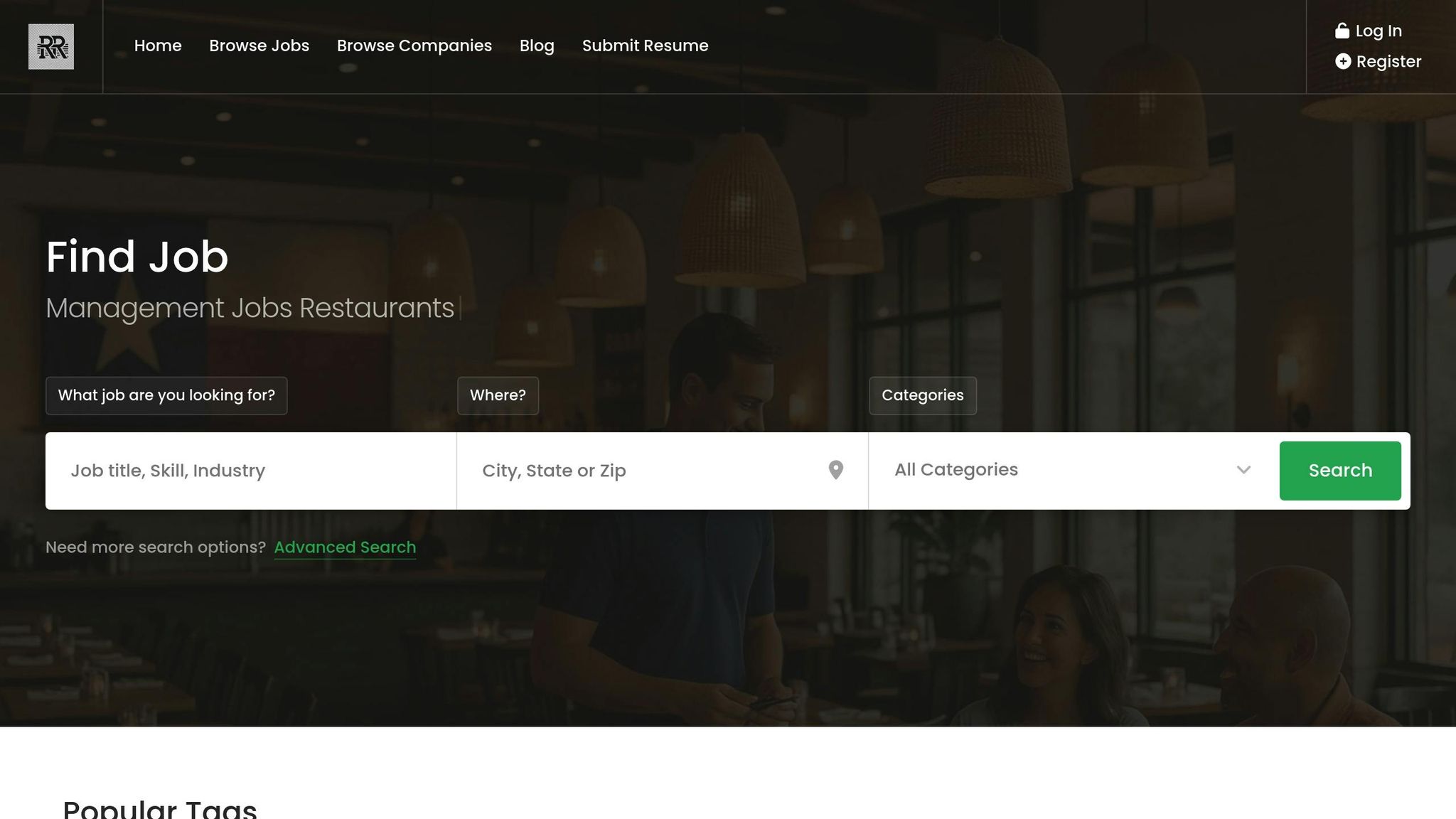
A well-crafted professional summary can make all the difference when applying through RR Guy. Instead of using a one-size-fits-all approach, tailor your summary to match the specific job posting. This strategy helps you align with the employer’s priorities and stand out from the competition.
Start by carefully reading each job description and identifying key terms like "P&L management", "guest relations", "inventory control", or even specific POS systems like Toast or Square. Incorporate these keywords into your summary to reflect the employer’s needs. For example, if the job listing highlights "staff coaching" rather than "team training", use their exact phrasing. This not only ensures compatibility with applicant tracking systems (ATS) but also resonates with recruiters right away.
"Choosing the right resume skills is important for aligning with employer expectations and passing automated screening systems. Including relevant skills can significantly improve your chances of being shortlisted." – LiveCareer
Beyond keywords, aim for a balance between technical and interpersonal skills. Highlight hard skills like budgeting, P&L management, or inventory control alongside soft skills such as conflict resolution and staff motivation. A recent analysis of over 5,000 management resumes from 2023-2024 revealed that Leadership, Customer Service, and Conflict Resolution were the most frequently listed skills on successful applications. Use active, impactful verbs from the job description, like "streamlined", "mentored", or "generated", to create a dynamic and engaging summary.
Take advantage of RR Guy’s candidate dashboard to keep your resume up-to-date with new certifications, achievements, or metrics as your career progresses. Additionally, consider the type of restaurant mentioned in the job posting. For instance, fine dining establishments may prioritize guest experience, while fast-paced chain operations often value efficiency and logistics. Adjust your summary to reflect these nuances for each application.
Conclusion
Your professional summary is the very first thing hiring managers will notice, and you’ve got about 7 seconds to leave an impression. To stand out, focus on measurable accomplishments – think revenue increases, cost savings, improved employee retention, or higher guest satisfaction. This kind of clarity sets the tone for a results-oriented summary.
"A well-written resume summary serves as the first impression, highlighting your skills, experience, and passion for delivering exceptional dining experiences." – ResumeWorder
Use action-packed verbs like "Spearheaded", "Optimized", or "Mentored" alongside specific metrics, such as a 93% retention rate or a 27% reduction in costs, to showcase your leadership and impact. Don’t forget to highlight any certifications like ServSafe Food Protection Manager or Certified Restaurant Supervisor to back up your expertise.
Make sure to tailor your summary for each job application by weaving in keywords from the job description – whether it’s "P&L management", "inventory control", or familiarity with specific POS systems. This not only helps you navigate Applicant Tracking Systems but also signals to employers that you’re aligned with their needs. Keep your summary short and impactful – 3 to 4 sentences – and refresh it regularly to include your latest achievements and certifications.
FAQs
How can I highlight measurable achievements as a restaurant leader?
To highlight your accomplishments as a restaurant leader, focus on measurable outcomes that clearly show your contributions. For instance, you could mention boosting monthly sales by 15%, increasing customer satisfaction ratings from 4.2 to 4.8, or reducing food waste by 20%. These numbers provide concrete evidence of your success.
Make sure to connect these results to the specific actions you took. Did you roll out a new training program? Improve inventory management? Or maybe you introduced a well-received promotion? By linking your achievements to your initiatives, you emphasize both your skills and the tangible value you bring to the team.
What metrics should I highlight in my professional summary for a restaurant management role?
When writing your professional summary for a restaurant management position, it’s essential to emphasize measurable achievements that reflect your leadership and impact. For instance, highlight successes like boosting revenue by 15%, cutting waste by 25%, or enhancing team productivity by 30%.
Don’t forget to include customer-focused wins, such as raising satisfaction scores by 20% or increasing repeat visits by 18%.
By showcasing specific, quantifiable results, you demonstrate your ability to achieve real outcomes, making your experience more compelling to employers.
How can I write a strong professional summary for a restaurant leadership role?
To write a standout professional summary for a restaurant leadership role, focus on emphasizing your most relevant skills, accomplishments, and experience. Start by showcasing your expertise in leadership, operational efficiency, and team management. Back this up with measurable achievements – think boosting sales, enhancing customer satisfaction, or optimizing workflows.
Make sure to tailor your summary to the specific job you’re applying for. For instance, if the role prioritizes staff development, highlight your success in training and mentoring team members. Use strong, action-oriented language to reflect your proactive mindset and problem-solving skills. A well-crafted, results-focused summary can set you apart and catch the attention of hiring managers.