
Restaurant Manager Salaries by State 2025
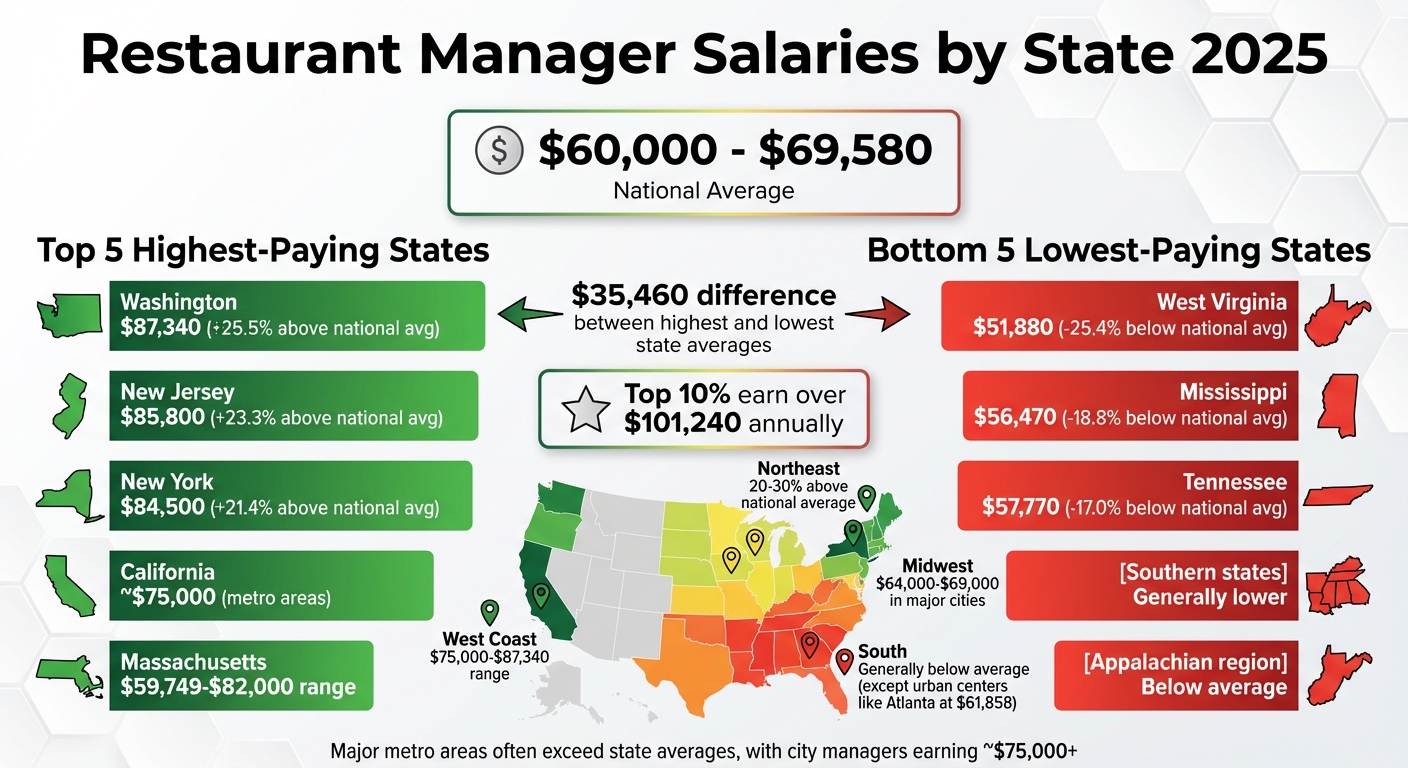
Restaurant manager salaries vary widely across the United States in 2025, with a national average of $60,000–$69,580. Washington offers the highest average at $87,340, while West Virginia ranks lowest at $51,880. Key factors influencing pay include cost of living, local labor markets, and restaurant density. Coastal states like New York ($84,500) and New Jersey ($85,800) lead in salaries, while Southern states like Mississippi ($56,470) and Tennessee ($57,770) lag behind.
For job seekers, focusing on high-paying states or metro areas can boost earnings, but higher living costs in these regions may offset gains. Tools like RR Guy can help compare opportunities, filter jobs by salary, and maximize career potential. Understanding these trends is essential for negotiating pay or planning relocations.
Restaurant Manager Salaries by State 2025: Top vs Bottom Paying States
1. Average Restaurant Manager Salaries by State
Restaurant manager salaries in 2025 show significant variation depending on location. While the national average hovers between $60,000 and $69,580 per year, state-specific data reveals a clearer picture of the disparities.
Washington leads the pack with an average annual salary of $87,340, trailed by New Jersey at $85,800 and New York at $84,500. On the other end of the spectrum, West Virginia records the lowest average at $51,880, followed by Mississippi at $56,470 and Tennessee at $57,770. This creates a striking gap of over $35,000 between the highest and lowest averages, which can significantly influence quality of life and financial planning.
The table below highlights how salaries in each state compare to the national average. Unsurprisingly, coastal states and urbanized areas dominate the higher salary brackets, while many Southern and Appalachian states fall below the benchmark.
| State | Average Annual Salary | Difference vs. National Average ($69,580) |
|---|---|---|
| Washington | $87,340 | +$17,760 (+25.5%) |
| New Jersey | $85,800 | +$16,220 (+23.3%) |
| New York | $84,500 | +$14,920 (+21.4%) |
| Tennessee | $57,770 | -$11,810 (-17.0%) |
| Mississippi | $56,470 | -$13,110 (-18.8%) |
| West Virginia | $51,880 | -$17,700 (-25.4%) |
Interestingly, salaries in major metropolitan areas often exceed both state and national averages, with many city-based restaurant managers earning around $75,000 annually. For job seekers, focusing searches on high-paying states and cities can open doors to better opportunities. These comparisons provide a foundation for understanding broader regional salary trends in the restaurant industry.
2. Regional Salary Patterns
When looking at salaries across different regions, it’s clear that local economies play a major role in shaping compensation. By diving into state-specific data, we can see how broader economic forces influence these patterns.
In the Northeast, managers tend to earn higher wages, consistent with the earlier state-level averages. This reflects the region’s high cost of living, which often pushes salaries 20–30% above the national average. For instance, managers in Philadelphia earn around $64,530, while in Massachusetts, the average is approximately $59,749, with some top earners reaching as high as $82,000.
Out West, salaries are notably strong. Washington reports an average of $87,340, while coastal cities like Los Angeles and San Francisco hover near $75,000. In places like Everett, wages can climb to $83,000. The demand for skilled managers in tourism-heavy areas and upscale dining establishments helps keep wages competitive in this region.
In the Midwest, cities such as Chicago, Cincinnati, and Columbus offer average salaries ranging from $64,000 to $69,000. These industrial hubs maintain solid pay levels, though they don’t face the same cost-of-living pressures as coastal cities.
Meanwhile, the South generally has lower salary averages compared to coastal regions. Urban centers like Atlanta are an exception, where managers earn around $61,858. However, lower population density across much of the South keeps wages more modest, though growing metro areas are starting to narrow the gap.
These regional trends provide valuable context for understanding the job market dynamics in restaurant management roles.
3. Finding Restaurant Management Jobs
If you’re on the hunt for restaurant management positions, focusing on competitive pay is a smart move. A great tool to streamline your search is RR Guy (Restaurant Recruiter Guy) – a specialized job board designed specifically for restaurant management roles. It allows you to easily explore opportunities across different states and compare job offers side by side.
With RR Guy, you can narrow your search by location and restaurant type – whether it’s casual, fast casual, fine dining, or multi-unit operations. You can also apply salary filters to prioritize positions that pay above the national average of approximately $60,000. For those aiming higher, set alerts for states like California, New York, or Massachusetts, where salaries tend to be more competitive. This way, you’ll be among the first to know when high-paying roles become available.
To maximize your chances, make sure your resume is tailored to stand out. When submitting through RR Guy, emphasize measurable accomplishments. For instance, mention achievements like increasing EBITDA by 4%, reducing food costs by 1.5 percentage points, or boosting the average check amount by $3. These specific results show potential employers that you’re equipped to handle roles in upscale or high-volume restaurants, where salaries can climb to $70,000–$90,000 or more. Additionally, many job postings on RR Guy include details about bonus structures, benefits, and expected work hours, helping you assess the total compensation package – not just the base salary.
sbb-itb-306cd44
Pros and Cons
High-Paying vs. Low-Paying States Comparison
When looking at salary variations across regions, it’s important to weigh how these numbers fit into your overall lifestyle and career goals. Choosing a state often comes down to balancing higher salaries against potentially higher living costs.
High-paying states like Washington ($87,340), New Jersey ($85,800), and New York ($84,500) offer attractive salaries, especially in major cities where earnings can exceed $90,000 with performance bonuses. However, these advantages come with challenges. High living expenses in cities like New York City or San Francisco can significantly reduce the value of those higher paychecks when factoring in rent, taxes, and daily costs. Additionally, these areas often bring more competition for jobs, longer work hours (50–60 hours per week), and increased stress levels.
On the flip side, states such as Tennessee ($57,770), Mississippi ($56,470), and West Virginia ($51,880) offer lower base salaries but make up for it with a lower cost of living. In these regions, your paycheck stretches further, making daily expenses more manageable. Job markets in these states tend to be less competitive, with slower-paced work environments and better work-life balance. However, you might find fewer opportunities for high-paying bonuses, prestigious roles, or rapid career advancement compared to larger, more competitive markets.
Here’s a quick comparison of the pros and cons of high-paying versus low-paying states:
| Aspect | High-Paying States (WA, NJ, NY) | Low-Paying States (TN, MS, WV) |
|---|---|---|
| Salary Range | $84,500–$90,000+ in top roles | $51,880–$57,770 typical base |
| Cost of Living | Higher; reduces salary value | Lower; more purchasing power |
| Job Competition | High; many qualified candidates | Lower; easier to secure positions |
| Work Hours | 50–60+ hours/week; high stress | Balanced; less demanding |
| Bonuses & Benefits | Structured, tied to KPIs | Smaller or informal perks |
| Career Growth | Corporate and multi-unit paths | Limited advancement opportunities |
To help you navigate these trade-offs, RR Guy provides tools tailored to your career and lifestyle preferences. You can filter job listings by location, restaurant type, and salary range, while also receiving job alerts and tracking applications through a personal dashboard. With dedicated recruiter support, you’ll get personalized advice to align your financial goals with your desired lifestyle – whether that means maximizing earnings in a bustling city or finding a better work-life balance in a more affordable state.
Conclusion
Restaurant manager salaries in 2025 show a wide gap of over $35,000 between the highest- and lowest-paying states. The top-paying states far outpace regions like Tennessee ($57,770), Mississippi ($56,470), and West Virginia ($51,880). On a national scale, salaries generally range from $59,000 to $69,580, with the top 10% earning more than $101,240 annually.
Beyond geography, factors like job role and industry type play a big role in determining pay. Managers in upscale establishments typically earn more, while major cities like New York City boast average salaries around $90,180 per year. On top of that, performance bonuses tied to metrics like revenue and guest satisfaction can significantly boost income.
Given the stark regional differences in pay, a strategic job search is key. Focusing on higher-paying roles can make a big difference, and platforms like RR Guy are designed to help. They offer tools to filter restaurant management jobs by state, salary range, and restaurant type – whether you’re eyeing casual dining or fine dining. You can set up alerts for high-paying states, upload your resume, track applications, and even receive personalized recruiter support to match your salary goals with your lifestyle preferences.
FAQs
How does the cost of living influence restaurant manager salaries in higher-paying states?
The cost of living heavily influences restaurant manager salaries in states where pay tends to be higher. States like California, New York, and Illinois often offer elevated wages to help employees manage the higher expenses associated with housing, transportation, and everyday essentials.
That said, these higher salaries don’t always mean managers enjoy greater financial freedom. In many cases, the steep cost of living in these areas can eat into their earnings, leaving their purchasing power comparable to – or only slightly ahead of – what managers in lower-cost states experience. The goal is to help managers maintain a reasonable quality of life despite the economic challenges tied to their location.
How can restaurant managers successfully negotiate a higher salary?
Restaurant managers looking to negotiate a higher salary should focus on demonstrating their value with concrete examples. Share measurable accomplishments, such as increasing revenue, enhancing customer satisfaction scores, or cutting operational costs. These achievements show your impact and justify your request.
It’s also smart to stay updated on industry salary trends and regional benchmarks. This knowledge not only helps you set realistic expectations but also strengthens your argument during discussions.
Another way to stand out is by gaining specialized skills or certifications that complement your role. These credentials highlight your commitment to professional growth and make you a stronger candidate. Lastly, nurturing solid relationships with your employer and proactively discussing your career goals can position you for success when it’s time to negotiate.
How can RR Guy help me find well-paying restaurant management jobs?
RR Guy provides a straightforward way to find well-paying restaurant management jobs through its specialized platform designed just for this industry. Job seekers can browse an extensive list of opportunities, upload their resumes, and create personalized job alerts to stay updated on the latest openings.
The platform also makes the hiring process smoother by allowing direct interaction with leading restaurant employers. This means you can easily connect with roles that align with your skills and salary goals. Whether you’re aiming for a position in casual dining, fine dining, or another category, RR Guy simplifies your search to help you secure the job that fits you best.